Showing posts with label Hollywood. Show all posts

Monday, March 27, 2023

Movie Monday: Centennial Summer

Movie Monday: Centennial Summer

As most of you know, I adore watching old movies, especially those produced during the 1930s and 1940s. But I was doubly happy when I unearthed the 1946 film Centennial Summer which is set during the 1876 Philadelphia Centennial Exposition – the same setting as my recent release Maeve’s Pledge.

In 1944, MGM had a smash hit Meet Me in St. Louis starring Judy Garland, Margaret O’Brien, and Mary Astor. Adapted from a series of short stories, the movie was a series of seasonal vignettes that take place between the summer of 1903 and the spring of 1904 when the Louisiana Purchase Exposition (1904 World’s Fair) begins. Meet Me in St. Louis was the second-highest-grossing movie of 1944.

Produced by 20th Century Fox, Centennial Summer was based on a 1943 book by Albert E. Idell, a
novelist long forgotten, but a prolific writer of more than forty books. I couldn’t find much about him other than he was born in 1901 and passed away in 1958. The plot is a simple romance: two sisters contend for the affections of a visiting Frenchman who is in Philadelphia to prepare his country’s pavilion for the exposition.

Despite being a musical, the three leads had their singing voices dubbed. Jeanne Crain, one of the sisters, had her first major role in the 1944 Home in Indiana, and the film established her as a “name” in the industry. This led to her being cast in several movies throughout the rest of 1944 and into 1945. Interestingly, she was often cast in musicals with Louanne Hogan providing her singing voice. Linda Darnell was cast as the other sister after coming off the success of Summer Storm, and Hungarian-born Cornel Wilde (birth name: Kornél Lajos Weisz) played the Frenchman. I’d never heard of Wilde despite him being in several dozen films and TV shows. Dorothy Gish and Walter Brennan are the girl’s long-suffering parents.

The movie was director Otto Preminger’s first color film and received two Academy Award nominations: Best Original Song for All Through the Day (Jerome Kern and Oscar Hammerstein II) and Best Music, Scoring of a Musical Picture. The movie only earned slightly more than it cost to produce, and fans and critics panned it.

Was it as terrible as some have claimed? You be the judge: https://www.youtube.com/watch?v=PJg1t3CI4O4

____________________

Maeve’s Pledge
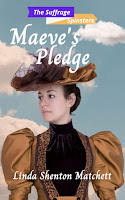
Pledges can’t be broken, can they?


Finally out from under her father’s tyrannical thumb, Maeve Wycliffe can live life on her terms. So what if everyone sees her as a spinster to be pitied. She’ll funnel her energies into what matters most: helping the less fortunate and getting women the right to vote. When she’s forced to team up with the local newspaper editor to further the cause, will her pledge to remain single get cropped?

Widower Gus Deighton sees no reason to tempt fate that he can find happiness a second time around. Well past his prime, who would want him anyway? He’ll continue to run his newspaper and cover Philadelphia’s upcoming centennial celebration. But when the local women’s suffrage group agrees that the wealthy, attractive, and very single Maeve Wycliffe act as their liaison, he finds it difficult to remain objective.

Purchase Link: https://amzn.to/3T50xRq

Monday, May 10, 2021

Mystery Monday: Thirteen Women

Mystery Monday: Thirteen Women 


Most folks are familiar with Myrna Loy’s iconic role as Nora Charles, the rich, plucky, and sleuth-wanna-be wife of William Powell’s detective Nick Charles. But Loy had an extensive film career long before she stepped into the fashionable role created by Dashiell Hammett. She appeared in more than forty films, silent and talkies, by the time she appeared at the Eurasian villain Ursula Georgi in Thirteen Women. 
 
The 1932 film was based on the 1930 best-selling novel by (Mr.) Tiffany Thayer. Made during the pre-code Hollywood era, the movie is a psychological thriller that film scholars claim also contains elements that make it a horror film and a pre-cursor to the slasher sub-genre. 
 
Pre-code Hollywood was “a period between the adoption of sound in pictures in 1929 and the
enforcement of the Motional Picture Production Code censorship guidelines in mid-1934.” (Wikipedia). The code had been adopted in 1930, but enforcement nearly nonexistent. Films produced during these years either depicted or implied sexual innuendo, romantic and/or sexual interracial relationships, mild profanity, illegal drug use, promiscuity, prostitution, infidelity, abortion, violence, and homosexuality. Villains often profited from their actions, many times without repercussions. In Thirteen Women, the rape of Myrna Loy’s character is alluded to during a conversation. 
 
Cited as an early “female ensemble” film, the movie is about a group of women who were sorority sisters at an all-girls college. They keep in touch after graduation through a series of round-robin letters. One of the women gets them involved with a clairvoyant swami who mails them each a horoscope indicating their doom. The swami is under the sway of Ursula who had been snubbed at the school because of her mixed-race heritage; behaviors that forced her to leave school. She now desires revenge and manipulates the women into killing themselves or each other. She even manages to influence the swami to kill himself. Ultimately, a showdown comes between Ursula and one of the women, Laura Stanhope, played by Irene Dunne. 
 
The film was produced by David Selznick (best known for Gone with the Wind and Rebecca) and premiered in October of 1932 in New York City. A month later it was released in LA and a few other cities. The following year saw a limited national release. With the growing popularity of Dunne and Loy, the studio edited out fourteen minutes and re-released the film in 1935 (post-Code).

Have you seen this intriguing movie? Here is a preview clip: Thirteen Women

_____________________ 

Murder at Madison Square Garden

The dream of a lifetime becomes a nightmare. 

Photojournalist Theodora “Teddy” Schafer’s career has hit the skids thanks to rumors of plagiarism. With any luck, a photo spread with Charles Lindbergh at the America First Rally will salvage her reputation. After an attempted assassination of Lindbergh leaves another man dead, Teddy is left holding the gun. Literally. Can she prove her innocence before the police lock her up for a murder she didn’t commit? 

Private Investigator Ric Bogart wants nothing to do with women after his wife cleaned out their bank account and left him for another man, but he can’t ignore the feeling he’s supposed to help the scrappy, female reporter who is arrested for murder at the America First rally. Can he believe her claims of innocence and find the real killer without letting Teddy steal his heart?

Purchase Link: books2read.com/u/31qK17