Showing posts with label Western Wednesday. Show all posts

Wednesday, June 8, 2022

Western Wednesday: Medicine in the Olden Days

Western Wednesday: Medicine in the Olden Days 

Photo: Pixabay/Steve Buissinne
Got a headache? Grab some aspirin or other pain reliever. How about bronchitis or strep throat? The doctor will give you a prescription for an antibiotic. But it hasn’t been that long since an infection, even a minor one, could conceivably kill its victim. Penicillin was accidentally discovered in 1928, but it would be nearly twenty years before the drug was fully developed and available on a wide scale (thanks mostly to the need generated by WWII). 

So what did folks do before modern drugs? 

Medicine in the 1700s: 
  • Headaches, dropsy (swelling), and stomach pains: teas infused with lavender, rosemary, wormwood, sage, foxglove, and mint. 
  • Fever: Wine “sharpened with lemon juice” or water gruel, orange whey, or weak chamomile tea 
  • Bleeding was also a popular “cure” that often created more problems than it solved!

1800s: 
  • Itchy skin and/or infection prevention: Camphor 
  • Diarrhea: Opium. 
  • Arthritis: Apple pectin mixed into juice. 
  • Insect stings: Honey 
  • Burns: Cloths soaked in tea
  • Indigestion: baking soda solution
  • Coughs (and many other ills): Castor oil 
  • Sore throat: Saltwater gargle (still used today!) 
Pixabay/Terri Cnudde
Then there were solutions for “female problems” such as motherwort tea to “calm the nerves.” Painful menstruation was treated with a tea made from red raspberry leaves. This was also thought to cure infertility. Labor pains were treated with blue cohosh and menopause with black cohosh. Fainting spells were treated with a tablespoon of vinegar. Calendula tea was used to cure bladder infections, and chamomile tea was used as a cure-all for everything from menopause to insomnia. 

A frightening “cure” that was part of medicine for nearly five hundred years was mercury. Thought to rejuvenate the body, it was most popular for sexually transmitted diseases such as syphilis. Unfortunately, it eventually caused deformities before killing the patient. 

Another common remedy was a mustard poultice. Used for chronic aches and pains as well as to ease chest congestion, the poultice (a soft moist mass) was made from mustard seed powder spread inside a protective dressing. The key was not to leave it in place for too long because it could cause first-degree burns! The vapor could cause nausea. Other poultices were created with dried crumbled bread mixed with sweet milk. Sometimes egg whites, crushed boiled onions, cornmeal or wheat bran were added. 

Pixabay/ArtActiveArt
The wife/mother was typically responsible for the health of the family, and many eventually learned the healing properties of the various herbs native to their location. It is debatable whether the home herb garden or vegetable garden was more important. I can’t imagine having to crush, cook, or infuse my medicine all the while wondering if it would work. 


 ___________________ 


She’s running for her life. He needs a trophy wife. They didn’t count on falling in love. 

Ellie Wagner is fine being a spinster school teacher. Then she witnesses a bank hold up and can identify the bandits. Fellow robbery victim Milly Crenshaw happens to run the Westward Home & Hearts Matrimonial Agency so she arranges for Ellie to head West as a mail-order bride. But her groom only wants a business arrangement. Can she survive a loveless marriage? 

Banker Julian Sheffield is more comfortable with numbers than with people, but he’s done well for himself. Then the bank president tells him that in order to advance further he must marry in six weeks’ time. The candid, unsophisticated woman sent by the agency is nothing like he expected, but time is running out. When her past comes calling, does he have what it takes to ensure their future?

Wednesday, May 11, 2022

Western Wednesday: Shopping in the Old West

Western Wednesday: Shopping in the Old West

Photo: Pixabay/
Sabrian Eickhoff
What do you think of when you hear the term “Old West?” Probably cowboys or ranches. Maybe saloons. But one mainstay of life in the towns that sprang up across the country during the 1800s is the general store, also known as a mercantile. Unlike the cities of the time that featured specialized boutiques, these small hamlets were remote, serving a population that had little time for shopping and often limited funds. 

The goal of the general store was to provide whatever the locals needed. Patrons could find tobacco, cigars, hardware, jewelry, buggy whips, horse tack, lanterns, pails, foodstuffs, fabric and sewing notions, household items, tools, small farm implements, soap, crockery, dishes, guns and bullets, clothing, candy, coffee, toiletries, school supplies such as slates and chalk, and patent medicines (most of which were untested and alcohol-based!). 

Merchandise could be purchased with cash or barter items, such as milk, eggs, or surplus produce. Shopkeepers also extended credit as necessary. In 1853, customers could expect to pay eight to ten cents per pound for rice, eleven cents per pound for pork versus nine cents per pound of salt beef. Fresh beef could be had for five cents per pound, whereas lard would run them up to twelve cents per pound. 

Many general store owners began as roving peddlers. After accumulating enough capital and inventory, they would establish a permanent location in a growing settlement. Others specifically sought one of the boomtowns such as a mining camp or railroad town. Sometimes, the mercantile would be the first business in a new settlement. 

Photo: Pixabay/
Brigette Werner
In addition to providing for the physical needs of the community, the general store was often the social center. A collection of chairs encircled the massive woodstove that was often located in the middle of the store. Some merchants offered inexpensive snacks such as soda crackers to allow folks to “sit a spell.” In his book, Pill, Petticoats, and Plows: The Southern Country Store, Thomas Clark indicated “Fox races, tobacco, cotton, horses, women, politics, religion—no subject is barred from the most serious and light-hearted conversation.” 

As the communications center of the town, the general store was typically the location of the post office with the owner acting as postmaster, sometimes even town clerk, Justice of the Peace, and/or undertaker. In later days, the mercantile was the first or only place in the town with a telephone. Less formal communication included a wall filled with lost and found notices, event flyers, election information, auctions, and “wanted posters” for outlaws. 

Keeping the shop clean would have been a challenge. With unpaved roads, customers tracked in dirt and other detritus, and the wood stove produced soot that settled on the goods. One report I found indicated it was not unusual to discover rodents foraging inside the store. 

Photo: Pixabay/
flockine
The late 1800s saw the advent of the mail order catalog business with Tiffany’s Blue Book considered the first in the U.S. In 1872, Aaron Montgomery Ward sent out his first “catalog,” a single sheet of paper showing merchandise for sale and including ordering instructions. Twenty years later, he was sending out a 540-page illustrated book selling 20,000 items, including prefabricated kit houses. Sears followed in 1888, and the decline of the general store began. The coming of the automobile in 1910 gave farmers and ranchers greater mobility, and as towns grew in size, the population was able to support specialized shops. 

There are remnants of general stores scattered around the U.S., and you may be pleasantly surprised to find one near you.

This article is a reprint of a guest post I did in February 2021. 

__________________

Gold Rush Bride Tegan

She’s out to prove herself. He’s only looking for adventure. Neither one realizes they’ll find more than gold “in them thar hills.” 

Tegan Llewellyn has always been different than her adopted family, except Grandmother Hannah, a prospector during the 1829 Georgia gold rush. Now, seventy years later there are reports of gold in Nome, and the opportunity is too good to pass up. But Tegan doesn’t count on the dangers that strike from the moment she steps off the steamer, including the threat of losing her heart. 

Elijah Hunter has prospected for gold all over the US and Canada and likes being on the move. The last thing he expects to find on his latest search is a lady miner who proves to be nothing but trouble. Can he convince her that leaving is for her own good before it’s too late...for both of them?

Wednesday, April 13, 2022

Western Wednesday: Communication in the Old West

Western Wednesday: Communication in the Old West 

Photo: Pixabay/Jan Vasek

I’m not the most savvy of technology users, and I was a long holdout on getting a smartphone. Unsurprisingly, the need to keep up with and communicate with family was the impetus for my upgrade. Texting was excruciating on my tiny flip phone, and there was no ability to send or receive photos. 

Westward expansion after the American Civil War sent hundreds of thousands of people across the nation. Some fled to escape the horrors of the war, others because they lost their homes. A great number craved adventure. Whatever their reasons, individuals packed what would fit in a covered wagon, paid their fees to the trail boss, and set out for a new life. More than a few left behind family, and telephones wouldn’t become commonplace for decades. 

How did pioneers keep in touch? 

Photo: Pixabay/Ellen26
The most common way settlers communicated with their loved ones was through the mail service. Created in 1792 with the Postal Service Act, the US Postal Service was originally part of the federal government, then elevated to a cabinet-level department in 1872. It would not become an independent agency until the Postal Reorganization Act of 1970. 

Until 1851, mailing letters through the Postal Service was an expensive proposition and did not serve many areas of the country. Additionally, there was no “regular delivery. As a result, most people used private means. Sometimes it was as easy as giving the letter to a friend, relative, business associate, or even stranger who was “heading that direction.” Another means was to hand the correspondence to the captain of a ship (Law required them to deliver all mail to the nearest post office at the first port of entry, but research indicates that didn’t always happen.) 
 
Stagecoaches were another avenue to send correspondence. In addition to people, they carried, bags, packages, and letters. Before 1810, stagecoaches were allowed to carry letters unless the route had been designated by Congress as a post road. After the Postal Act of 1810, it was unlawful for stages to carry mail on a post road or road adjacent to a post road. However, some drivers continued to offer the service. 
 
Photo: Public Domain
Private express companies (the forerunners to UPS/FedEx, etc.) were often used to carry money, packages, and legal documents, but were also known to convey letters. Until the Pony Express which delivered in ten days, then later through the use of trains, letters could take weeks, if not months to travel across the country. The telegraph was invented in 1844, but was expensive and only used in cases of emergencies. Early settlers would be amazed at the thought of cell phone usage that crosses oceans. I know I am. 

_____________________

Ellie’s Escape 

She’s running for her life. He needs a trophy wife. They didn’t count on falling in love. 

Ellie Wagner is fine being a spinster school teacher. Then she witnesses a bank hold up and can identify the bandits. Fellow robbery victim Milly Crenshaw happens to run the Westward Home & Hearts Matrimonial Agency so she arranges for Ellie to head West as a mail-order bride. But her groom only wants a business arrangement. Can she survive a loveless marriage? 

Banker Julian Sheffield is more comfortable with numbers than with people, but he’s done well for himself. Then the bank president tells him that in order to advance further he must marry in six weeks’ time. The candid, unsophisticated woman sent by the agency is nothing like he expected, but time is running out. When her past comes calling, does he have what it takes to ensure their future?

Wednesday, December 22, 2021

Western Wednesday: Christmas in the Old West

Western Wednesday: Christmas in the Old West 
 
Photo: public domain
Life in the Old West is sometimes romanticized, with images of Ma and Pa rocking on the front porch, kids playing in the yard. Or perhaps seated around the rustic kitchen table partaking of a nice New England pot roast dinner. For some families, that may have been true, but in the early days of settling the West, most folks had a different experience. 
 
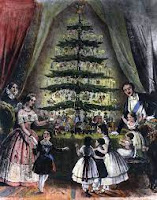
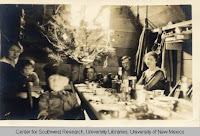
Christmas trees were popularized in the mid-1800s when Queen Victoria’s German husband brought the tradition from his homeland. Magazines picked up the story, and soon Americans embraced the practice as well. Living in the prairie where trees were scarce, most homesteaders probably didn’t put up a tree, but stockings and other decorations were popular. For those who did put up a tree, ornaments were bits of ribbon or yarn, berries, popcorn or paper strings, and other homemade decorations. 
 
The holiday meal was a big deal, and women pulled out all the stops to create a feast. Their husbands
Photo: UNM Archives
went hunting for game, while they baked bread and sweets as well as brought out preserved fruits and vegetables. Plum pudding would have been prepared well ahead to allow it time to age before Christmas dinner. 
 
Gifts would have been simple and primarily homemade, either because of the financial situation of the family or the lack of items available. Cornhusk or rag dolls for little girls, carved wooden toys, embroidered hankies, pillows, scarves, hats, mittens, and socks would be worked on during the year. If the family had a successful year, children might also find candy and other store-bought goodies in their stockings. 
 
Photo: WikiImages

Christmas eve traditions differed for each family, but many would gather to sing carols around the fireplace. On Christmas Day, most would head to church for a special service, then return home for the big meal and opening of presents. Afterward, if the weather was fine, they would travel around the community visiting with friends and neighbors. 
 
Wishing you a blessed Christmas and Happy New Year! 


____________________________
 
A Doctor in the House: A Christmas Romance

They’re supposed to be allies, but mutual distrust puts this pair on opposite sides. 
 
Emma O’Sullivan is one of the first female doctors to enlist after President Franklin Roosevelt signs the order allowing women in the Army and Navy medical corps. Within weeks, Emma is assigned to England to set up a convalescent hospital. She leaves behind everything that is familiar and arrives in the unfamiliar country a short time before Christmas. When the handsome widower of the requisitioned property claims she’s incompetent and tries to get her transferred, she must prove to her superiors she’s more than capable. But she’s soon drawn to the good-looking, grieving owner. Will she have to choose between her job and her heart? 
 
Archibald “Archie” Heron is the last survivor of the Heron dynasty, his two older brothers having been lost at Dunkirk and Trondheim and his parents in the Blitz. After his wife is killed in a bombing raid while visiting Brighton, he begins to feel like a modern-day Job. To add insult to injury, the British government requisitions his country estate, Heron Hall, for the U.S. Army to use as a hospital. The last straw is when the hospital administrator turns out to be a fiery, ginger-haired American woman. She’s got to go. Or does she?

Purchase Link: https://amzn.to/3E9HVXb

Wednesday, December 1, 2021

Western Wednesday: Zane Grey, America's Storyteller

Western Wednesday: Zane Grey, America's Storyteller 

Part of my research for stories includes reading books from the time period I’m investigating, and I recently came across the works of Zane Grey while preparing for a series I’ll be releasing in 2022. I had heard of him, along with Louis L’Amour, as two of the best authors in classic western literature. The more I dug, the more intrigued I became. 
 
Pearl Zane Gray was born on January 31, 1872 in Zanesville, Ohio, a town founded by his mother’s ancestors. (Spelling of the family name was changed from Gray to Grey sometime in the late 1890s.) As a boy, he would hear stories of his forebear’s adventures as pioneers in America’s “First West,” the Ohio Valley. He would later novelize their stories and those of other homesteaders as well as ranchers, cowhands, buffalo hunters, soldiers, and gamblers as the migration westward continued. 
 
As a young man, Zane was an excellent baseball player whose abilities led to a scholarship to the University of Pennsylvania. He chose dentistry to please his father and graduated in 1896, but chose to play amateur baseball for several seasons, practicing his dentistry intermittently. In addition, he loved the outdoors and found great joy in fishing. He discovered the town of Lackawaxen, Pennsylvania and visited often. 
 
It was during one of his visits to Lackawaxen in 1900 that he met Lina Elise “Dolly” Roth, eleven years
his junior, while canoeing near the Delaware House, a boarding house on the river. By this time, he’d been writing, but had yet to find success. Dolly encouraged him to continue his efforts, and in 1902 his first article was published, “A Day on the Delaware,” in Recreation magazine. The following year he wrote, illustrated, and published his first novel, Betty Zane, with money from his sister-in-law Reba Grey. 
 
Dolly and Zane married in 1905, and he left dentistry to pursue his writing full-time. They settled in Lackawaxen, and the following year visited the Grand Canyon, Zane’s first trip out west. Times were lean as he tried to establish himself as an author. Using the last of Dolly’s inheritance, he went on a hunting expedition with Western conservationist Charles “Buffalo” Jones. He wrote about his experience in The Last of the Plainsmen which was published by Outing Press in 1908 and marked a turning point in his career. 
 
The Heritage of the Desert
came out in 1910, and his most famous work, Riders of the Purple Sage was published in 1912. By 1915, Zane had fifteen books in print along with many fishing and outdoor adventure articles and serialized stories. His success allowed him to purchase a home in Altadena, California and a hunting lodge on the Mogollon Rim near Payson, Arizona. Each year, he spent several months gathering experiences, then he would return home and craft his stories into tales for serialization, magazine articles, or a novel. 
 
Being in California allowed Zane to work closely with the motion picture industry which had begun producing films based on his novels. A prolific writer, he wrote ninety books before his death. Another twenty manuscripts were published posthumously. His novels and short stories have been adapted into 112 films, two television episodes, and a television series. 

Have you read any of his books? 

 ___________________ 
 
A brand-new widow, she doesn’t need another man in her life. He’s not looking for a wife. But when danger thrusts them together, will they change their minds...and hearts? 
 
Hannah Lauman’s husband has been murdered, but rather than grief, she feels...relief. She decides to remain in Georgia to work their gold claim, but a series of incidents makes it clear someone wants her gone...dead or alive. Is a chance at being a woman of means and independence worth risking her life? 

Jess Vogel never breaks a promise, so when he receives a letter from a former platoon mate about being in danger, he drops everything to help his old friend. Unfortunately, he arrives just in time for the funeral. Can he convince the man’s widow he’s there for her protection not for her money? 
 
Gold Rush Bride: Hannah is the first book in the exciting series Gold Rush Brides. Steeped in romance, intrigue, and history, the story will keep you turning pages long into the night.

Purchase Link: https://amzn.to/3d1iRXq

Wednesday, June 2, 2021

Western Wednesday: Gold Rush Bride Hannah

Western Wednesday: Gold Rush Bride Hannah 
 
I’m often asked where I get my story ideas and whether I’ll ever run out. With a folder chock-full of scraps and notes, I’ve got enough plotlines to keep me writing for a long time. My inspiration comes from numerous places: books or movies that I think should have been done differently, twists on Bible stories or fairy tales, newspaper headlines or magazine articles, museum displays, documentaries about people, places, or events, and snippets of conversation. 
 
The idea for Gold Rush Bride Hannah is partially the result of reading H.W. Brand’s The Age of Gold
(about the California gold rush). Jessie Benton Fremont, daughter of Missouri Senator Thomas Hart Benton, is mentioned prominently in the book. She and her husband were two of the thousands who participated in the California rush. Descriptions of her exploits got me curious about other female prospectors. In my research, I discovered that there were two major rushes prior to the one in California: one in North Carolina in 1799, and one in Georgia in 1829. Further study unearthed mention of women miners in Georgia, and I was able to find a couple of diaries as well. 
 
Many, like Jessie Fremont, came with their husbands, some of whom stayed to work the claim after being widowed. Others came with brothers or fathers. A small percentage were single and arrived on their own. My research revealed that the reasons for their desire to work the goldfields were as numerous as the women themselves: escaping a bad situation or tarnished reputation, few or no marriage prospects, a desire for financial independence, an opportunity for adventure, and as mentioned, following a husband or relative. Whatever their motivation, these women had grit and gumption, and I knew I had to share their exploits. 
 
Gold Rush Bride Hannah is the first in an exciting new multi-author series. Each month from now until December, a stand-alone gold rush story will be released. 
 
_________________

About Gold Rush Bride Hannah: 

A brand-new widow, she doesn’t need another man in her life. He’s not looking for a wife. But when danger thrusts them together, will they change their minds...and hearts? 
 
Hannah Lauman’s husband has been murdered, but rather than grief, she feels...relief. She decides to remain in Georgia to work their gold claim, but a series of incidents makes it clear someone wants her gone...dead or alive. Is a chance at being a woman of means and independence worth risking her life?
 
Jess Vogel never breaks a promise, so when he receives a letter from a former platoon mate about being in danger, he drops everything to help his old friend. Unfortunately, he arrives just in time for the funeral. Can he convince the man’s widow he’s there for her protection not for her money?

Purchase link: https://amzn.to/3oZVpz5