Showing posts with label ##WWII. Show all posts

Thursday, May 19, 2022

Talkshow Thursday: Welcome back, Sherri Stewart!

Talkshow Thursday: Welcome Back, Sherri Stewart!

Linda: Thanks for joining me today. Congratulations on your recent release, A Song for Her Enemies Where did you get the inspiration for the story? 

Sherri: My publisher wanted to do a collection of stories about real female heroines from a fictional character’s point of view. My heroine has always been Corrie ten Boom, so I signed up to write a book about Neelie Visser, someone like Corrie, from the viewpoint of one of the Jewish guests she hid in her home during WWII. Since it had to be from a fictional character’s point of view, I wrote about Tamar Kaplan, a Jewish aspiring opera singer, who learned about Neelie’s God through their time together in hiding, then at the camps. 

LM: What is it that draws you to the World War II era, and when did you first develop the interest? 

Sherri: My interest in World War II fiction has grown since visiting holocaust museums in Israel and Washington D.C., reading Corrie ten Boom’s books, as well as other novels about that time, and visiting Vught Concentration Camp in the Netherlands. I am appalled at how one evil man could change the course of modern history. Most of the survivors have passed away, but their stories need to survive their deaths; otherwise, the world will let it happen again. 

LM: You’re working on the sequel, In Her Enemies House. Did you set out to write a series? What was your inspiration for this story? 

Photo: Pixabay/
Helena Jankovicova Kovacova
Sherri: I didn’t start out to write a series, but after I wrote A Song for Her Enemies, it occurred to me that the story of the holocaust survivors didn’t end when the war ended. People were physically alive, but the emotional scars they carried had long-term effects on their lives. In the Netherlands, a lot of survivors chose “the Conspiracy of Silence,” which meant they refused to talk about what happened. Since all their choices had been ripped away from them, silence was the one thing nobody could rip away. In the sequel which occurs three years after the war, Tamar Feldman craves justice, but all around her people are living as if the holocaust never happened, including her husband, Daniel, who tells her to bury the past and get on with life. 

LM: How long does it take you to write a book, and can you tell us about your process? 

Sherri: It all depends on the word count. A long book—95000 words—usually takes me a year to write because I spend hours every day editing my clients’ books, so my eyes get a bit tired. My general rule is to write 500 words a day, 6 days a week. Then the editing starts, which adds another month or two to the process. I’m a plantser, which means I have a general idea of where the book is headed, but I leave room for God to take me in all kinds of directions. 

LM: What did you edit out of this book? 

Sherri: What a great question! One thing I deleted was about the three-year-old son of Tamar’s nemesis, Margot, who had Amblyopia, a lazy eye. Tamar asked her husband, who’s a doctor, what could be done for the boy, and he mentioned wearing a patch, then surgery later. It seems I didn’t follow up on it. My sister who’s one of my beta readers noticed, and we decided that it didn’t move the story forward. Also, Margot doesn’t have much to commend her to the reader, but I don’t like my antagonists to be totally bad. Then they just become comic-book characters. 

LM: What is your next project? 

Photo: Pixabay/Arek Socha
Sherri: Right now I’m working on a romantic suspense novella for a collection of books coming out in the fall of 2022. The working title is The Girl with ‘Deer in the Headlights’ Eyes. When I was in law school, I wrote my third-year research paper on Tarasoff v. Regents of the University of California, which is about an attorney’s or counselor’s duty to warn the victim if they know their client might pose a threat to the victim. My book is about a girl who is being stalked by an obsessive guy, so she moves to Bar Harbor, Maine to get away from him. 

LM: Where can folks find you on the web? 

Sherri: 

Quarterly newsletter signup: http://eepurl.com/gZ-mv9
If you like historical tidbits, go to http://www.hhhistory.com

About A Song for Her Enemies: 

After Nazi soldiers close the opera and destroy Tamar Kaplan’s dream of becoming a professional singer, she joins the Dutch Resistance, her fair coloring concealing her Jewish heritage. Tamar partners with Dr. Daniel Feldman, and they risk their lives to help escaping refugees. When they are forced to flee themselves, violinist Neelie Visser takes them into hiding. 

Tamar’s love for Daniel flowers in hardship, but she struggles with the paradox that a loving God would allow the atrocities around her. When Tamar resists the advances of a Third Reich officer, he exacts his revenge by betraying the secrets hidden behind the walls of Neelie’s house. From a prison hospital to a Nazi celebration to a concentration camp, will the three of them survive to tell the world the secrets behind barbed wire?

A Song for Her Enemies is the story of a talented young opera singer and the bittersweet love that grows amid the tyranny and fear of World War II. Set against the backdrop of neighbors willing to risk their lives in the German-occupied, war-torn Netherlands, A Song for Her Enemies is an inspiring and beautiful novel celebrating the resilience of the human spirit and the determination of Christians in the face of persecution. It is a novel for everyone seeking to understand the pain of the past and be inspired to embrace hope for the future.

Tuesday, April 19, 2022

Traveling Tuesday: Spies in Other WWII Theaters

Traveling Tuesday: Spies in Other WWII Theaters 

Photo: WikiImages
As shared previously, (http://www.lindashentonmatchett.com/2022/04/traveling-tuesday-spies-in-wwii-france.html), many brave man and women worked as spies and resistance fighters in occupied France. However, thousands more worked around the globe in occupied and unoccupied areas to gather intelligence and thwart the plans and operations of the Axis powers. 

Born in Litmanova, Slovakia, Maria Gulovich was eighteen years old when World War II changed her life. A school teacher like her mother, Maria continued to teach even after Germany overran her country. Life was hard, but she managed. Early in 1944, a Jewish friend asked her to hide his sister and her five-year-old son. Later Maria would say, “I never intended to hide anyone. My sister brought the woman’s brother and he was crying and I’m a softie.” He asked if she could hide them for a few days under the woman could find something else. She never did. Maria was reported to the authorities, but fortunately for her the officer was a member of the Resistance. He agreed to move the woman if Maria would act as a courier for the Resistance. Additional tasks included smuggling radios and rescuing downed airmen. 

Photo: WikiImages
Krystyna Skarbek was a Polish agent of the British Special Operations Executive, and has been referred to as the “bravest of the brave.” Vera Atkins, her handler described her as “very brave, very attractive, but a loner and a law unto herself.” She served in France, Poland, and Hungary where she often posed as a journalist. She performed surveillance of the rail, river, and road traffic on the border between Germany and Romania and provided intelligences about Germany’s oil transports from Romania’s Ploiesti oilfields. At great risk to herself, she met with a Gestapo commander claiming to be a British agent and used threats, lies, and a two-million franc bribe to obtain the release of several SOE agents. She spent much of 1940 traveling between Poland and Hungary, obtaining crucial information that was passed to SOE headquarters. After being arrested in Budapest, she feigned symptoms of pulmonary tuberculosis by biting her tongue until it bled. The Germans released her, and she fled the country. 

Photo: WikiImages
A Russian whose family fled to France after the 1917 revolution, Nathalie “Lily” Sergueiew was a double agent who worked for MI5 under the code name “Treasure.” The German Intelligence Service tried to recruit her in 1937, but she declined. After France fell, she agreed to work for the Abwehr who sent her to Spain. Upon her arrival in Madrid, she contacted the MI5 representative (and how to you find that out??), indicated she was a German spy, and offered to work for British Intelligence. She was accepted and sent to England. Her handler noted that Lily was “exceptionally temperamental and troublesome.” She sent false information to the Germans, and is credited with playing a significant role in deceiving them about the location of the D-Day landings. Her messages were re-encrypted in the German Enigma machines, providing Bletchley Park with excellent “cribs” used by other Abwehr networks. After the liberation of France, she returned and served in the French Women’s Army Service.

 __________________ 

Spies & Sweethearts

She wants to do her part. He’s just trying to stay out of the stockade. Will two agents deep behind enemy lines find capture… or love? 

1942. Emily Strealer is tired of being told what she can’t do. Wanting to prove herself to her older sisters and do her part for the war effort, the high school French teacher joins the OSS and trains to become a covert operative. And when she completes her training, she finds herself parachuting into occupied France with her instructor to send radio signals to the Resistance. 

Major Gerard Lucas has always been a rogue. Transferring to the so-called “Office of Dirty Tricks” to escape a court-martial, he poses as a husband to one of his trainees on a dangerous secret mission. But when their cover is blown after only three weeks, he has to flee with the young schoolteacher to avoid Nazi arrest. 

Running for their lives, Emily clings to her mentor’s military experience during the harrowing three-hundred-mile trek to neutral Switzerland. And while Gerard can’t bear the thought of his partner falling into German hands, their forged papers might not be enough to get them over the border. Can the fugitive pair receive God’s grace to elude the SS and discover the future He intended?

Monday, April 11, 2022

Mystery Monday: Ian Fleming vs. James Bond

Mystery Monday: Ian Fleming vs. James Bond 
 
Photo: WikiImages
Most folks are familiar with James Bond even if they don’t read spy fiction/thrillers. According to creator/author Ian Fleming, Bond is the “compound of all the secret agents and commando types I met during the war.” Fleming wrote fourteen novels before his death, and thirty-four additional novels and short stories have been penned by other authors. Long before he left Naval Intelligence Division, Fleming told a friend he planned to become an author and “write the spy story to end all spy stories.” With his experience, he certainly had enough fodder. 
 
But where does Fleming end and Bond begin? 

Image commissioned
by Fleming
The character’s name was taken from that of American ornithologist James Bond, an expert on Caribbean birds and author of the definitive guide Birds of the West Indies. Fleming was an avid birdwatcher and owned a copy of Bond’s book. It is said he later told the man’s wife that “this brief, unromantic, Anglo-Saxon and yet very masculine name was just what I needed, and so a second James bond was born.” Other characters were given names of Fleming’s school friends, acquaintances, relatives, and lovers. 

Bond is described as having “black hair falling down over the right eyebrow...a bit cruel in the mouth, and the eyes were cold.” Some say Bond is a cross between Fleming and his friend, Hoagy Carmichael. Fleming also bestowed his own tastes and traits on Bond. Bond had the same golf handicap, loved scrambled eggs and gambling, and used Fleming’s brand of toiletries. In addition, like Fleming, the character was a womanizer, a heavy drinker, and smoked regularly. 

Photo: Pixabay/
Roberto Lee Cortes
Some scholars have posited that rather than an extension of Fleming, Bond is the author’s wish fulfillment, referencing the fact that the author spent most of the war at a desk, managing intelligent-gathering operations remotely. According to his biographer, Andrew Lycette, “He saw all these secret agents arriving from interesting assignations and he sort of decided he would have liked to have been more like them.” 
 
Perhaps. You be the judge. 

________________________________

Spies & Sweethearts

She wants to do her part. He’s just trying to stay out of the stockade. Will two agents deep behind enemy lines find capture… or love? 

1942. Emily Strealer is tired of being told what she can’t do. Wanting to prove herself to her older sisters and do her part for the war effort, the high school French teacher joins the OSS and trains to become a covert operative. And when she completes her training, she finds herself parachuting into occupied France with her instructor to send radio signals to the Resistance. 

Major Gerard Lucas has always been a rogue. Transferring to the so-called “Office of Dirty Tricks” to escape a court-martial, he poses as a husband to one of his trainees on a dangerous secret mission. But when their cover is blown after only three weeks, he has to flee with the young schoolteacher to avoid Nazi arrest. 

Running for their lives, Emily clings to her mentor’s military experience during the harrowing three-hundred-mile trek to neutral Switzerland. And while Gerard can’t bear the thought of his partner falling into German hands, their forged papers might not be enough to get them over the border. Can the fugitive pair receive God’s grace to elude the SS and discover the future He intended?

Tuesday, December 28, 2021

Traveling Tuesday: Sugar Hill, New Hampshire

Traveling Tuesday: Sugar Hill, New Hampshire 

author photo
Sugar Hill, New Hampshire is a tiny town about ninety minutes north of where I live. Nestled in the White Mountains, the town is named for the numerous sugar maples that dot the landscape. In the late 1800s, the area became a fashionable Victorian resort after the wealthy in Boston, Hartford, New York, and Philadelphia saw the paintings by White Mountain artists that were popular at the time. Hotels and hostelries were built, and rail service arrived in 1880. By 1900, the area boasted a 9-hole golf course and clubhouse, now on the National Register of Historic Places. 
 
That same year, Robert P. Peckett, Sr. purchased landed and opened the Peckett’s-on-Sugar-Hill-Inn. Trying to increase his winter traffic, he established the first resort-based ski school in the United States. (At this point, skiing was not a well-known sport in America.) Peckett recruited two German instructors, and the school became wildly successful. He continued to bring in European instructors, including Otto Lang. Some of the more famous students of the school were Nelson Rockefeller, Averell Harriman, and Lowell Thomas. 
 
By 1939, actress Bette Davis was ready for a break from Hollywood, having just completed two films. A
native New Englander from Lowell, Massachusetts, Bette decided a trip to New Hampshire would be a good cure-all. Familiar with NH and an avid skier after many trips to Europe, she made her way to Sugar Hill where she discovered Peckett’s-on-Sugar-Hill-Inn. During her stay, she fell in love with Arthur Farnsworth, the assistant manager, and they married the following year. Tragically, he died only three years later from a fall. 
 
Bette had so much pull that she told Jack Warner she would not attend the premiere for her movie “The Great Lie” if it was held in Hollywood. Instead, she insisted the event take place in New Hampshire, at The Jax Theater in Littleton. On her 33rd birthday, thousands of locals and Hollywood stars gathered to celebrate. Proceeds from the gala went to Littleton Hospital. (Check out this clip from NH television station WMUR: https://www.wmur.com/article/monday-july-9th-the-new-hampshire-home-built-by-bette-davis/22072670#) 
 
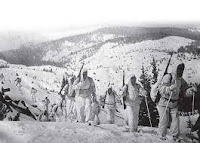
During WWII, Sugar Hill and the surrounding area would be used as training grounds for the 10th Mountain Division, the only one of its type in the military to receive intense specialized training for fighting in mountainous and arctic conditions. Made up of many young men who grew up skiing in the Northeast, the group spent much of their time in Franconia notch covering mountain travel, rock climbing techniques such as rappelling and belaying. Additionally, the hiking trails were the scenes of mock ambushes. Another aspect of their training was learning Norwegian, in the event they would be used to be sent to the fjords of Norway for an invasion. 
 
Although the grand hotels are mostly gone, Sugar Hill remains a popular location to visit year-round, and locals are still proud of their association to Bette as well as the part they played to train soldiers for the war. 

________________ 

A Doctor in the House (A WWII Christmas Romance): 

They’re supposed to be allies, but mutual distrust puts this pair on opposite sides. 
 
Emma O’Sullivan is one of the first female doctors to enlist after President Franklin Roosevelt signs the order allowing women in the Army and Navy medical corps. Within weeks, Emma is assigned to England to set up a convalescent hospital, and she leaves behind everything that is familiar. When the handsome widower of the requisitioned property claims she’s incompetent and tries to get her transferred, she must prove to her superiors she’s more than capable. But she’s soon drawn to the good-looking, grieving owner. Will she have to choose between her job and her heart? 
 
Archibald “Archie” Heron is the last survivor of the Heron dynasty, his two older brothers having been lost at Dunkirk and Trondheim and his parents in the Blitz. After his wife is killed in a bombing raid while visiting Brighton, he begins to feel like a modern-day Job. To add insult to injury, the British government requisitions his country estate, Heron Hall, for the U.S. Army to use as a hospital. The last straw is when the hospital administrator turns out to be a fiery, ginger-haired American woman. She’s got to go. Or does she?

Purchase Link: https://amzn.to/3Ju7ZjY

Tuesday, October 16, 2018

Traveling Tuesday: Maryland

Traveling Tuesday: Maryland

from www.getadrawing.com
Yesterday’s release, Murder of Convenience is set in Baltimore, so I thought I’d take the opportunity to focus on the state of Maryland and how they “did their bit” for the war effort.

As with all states, Maryland sent its citizens off to war, and even before the attack on Pearl Harbor, the state was preparing its National Guard units for combat. The 29th Infantry Division comprised of members from Maryland, Virginia, Pennsylvania, and the District of Columbia compiled one of the most distinguished records in the war with two Medals of Honor, forty-one Distinguished Service Crosses, 816 Silver Stars, 5,151 Bronze Stars, and countless Air Medals. In addition, the division received a Presidential Unit Citation.

Production of war materiel commenced as over 900 factories were converted from manufacturing peacetime commodities, such as Bethlehem Steel at Sparrows Point who produced nearly twenty tons of steel. The Bethlehem Fairfield shipyard build 374 Liberty ships, and shipyards around the state repaired over 10,000 vessels. Between them the George L. Martin Company and Fairfield Aircraft Division assembled over 16,000 planes.

Aberdeen Proving Grounds (a military installation where weapons or technology are tested or experimented with, or where military tactics are tested) and Andrews Air Force Base are perhaps the state’s most famous locations, but numerous airfields were created for training pilots and air crew. Many of these airports were converted to municipal airports, while others were returned to agricultural use. Hundreds of “temporary” buildings survive today and used for other purposes.

In 1940, University of Maryland was tapped by the U.S. Surgeon General to help form a Medical Reserve Corps. Two years later, two dozen graduates were activated for duty with the 42nd and 142nd General Hospitals and served in Australia, the Philippines, and Fuji. Eventually, more than 150 graduates went on to serve in all branches of the military.

I lived in Gaithersburg, Maryland for ten years and had no idea it was one of the twenty POW camps located in the state. Fort Meade received the first POWs in 1942 and ultimately housed more than 2,000 prisoners. POWs worked on local farms as well as at Bethesda’s Stonyhurst Quarry where they broke and loaded flagstone. Others cut pulp wood at Smith Point.

Victory gardens were a part of everyday life of course, but Henry Irr, president of Baltimore Federal Savings and Loan raised the production bar by sponsoring a statewide competition that included bonds as prizes. Not to be outdone, Constance Black, wife of Baltimore Sun executive Harry Black, converted the hill behind her mansion to a Victory Garden and then opened a neighborhood farm stand.

These are just a few of the way, the tiny state of Maryland pulled her weight during WWII.


May 1942: Geneva Alexander flees Philadelphia and joins the USO to escape the engagement her parents have arranged for her, only to wind up as the number one suspect in her betrothed’s murder investigation. Diagnosed with Retinitis Pigmentosa, she must find the real killer before she loses her sight…or is convicted for a crime she didn’t commit.

Set in the early days of America’s entry into WWII and featuring cameo appearances from Hollywood stars, Murder of Convenience is a tribute to individuals who served on the home front, especially those who did so in spite of personal difficulties, reminding us that service always comes as a result of sacrifice. Betrayal, blackmail, and a barrage of unanswered questions… Murder of Convenience is the first in the exciting new “Women of Courage” series.


Monday, October 8, 2018

Mystery Monday: Dame Margaret Cole


 Mystery Monday: Dame Margaret Cole

British mystery writer Margaret Cole who co-wrote over thirty detective stories with her husband G.D.H. Cole was a prolific author. Part of the Postgate family from the North York moors, Margaret also penned poetry and several nonfiction books. She later went into politics and was awarded a DBE. Her ancestor’s land grant was awarded in the year 1200, and through the centuries the family was notable in many fields including science, music, education, journalism, and entertainment. Film and stage actress Dame Angela Lansbury is Margaret’s cousin.

Margaret attended the Roedean School where she was very unhappy, later saying, “Roedean was, emphatically, the wrong sort of school for me. But I would go further and say it was not a good sort of school at all. It was very expensive; I only got in as the winner of the single annual scholarship.” She later attended Girton College (part of Cambridge), and finished all the requirements for a degree. (At that time most universities did not grant degrees to women.)

She and her family were staunch socialists and became pacifists during WWII. Her brother was jailed after his exemption as a conscientious objector was denied and he refused military orders. Her poem “The Falling Leaves” is one of her most famous works and is one of the first anti-war poems from a woman’s perspective. When Hitler began to overrun Europe, Margaret abandoned her pacifism, however she continued to be active in the socialist cause.

During a campaign against conscription, she met and married G.D.H. Cole. They joined the Fabian Society, an organization whose purpose is to advance the principles of democratic socialist via reformist efforts rather than revolutionary overthrow. The couple eventually moved to Oxford where they taught and wrote. Their first mystery novel “The Death of a Millionaire” was published in 1925. Published in 1948, their final novel was “The Toys of Death.” Series characters were Superintendent Henry Wilson, Everad Blatchington, and Dr. Tancred.

Their book “Murder at the Munition Works” was published in 1940, and the story is woven around wartime production, shop stewards, and walk-outs. Because of its topic, one scholar theorizes that Margaret’s husband wrote the book in its entirety rather than as a collaboration with her, however, there is no proof. Most readers agree that the Cole’s early works are their better novels with ingenious ideas, complex characterizations, and sharp satire.

And despite being considered as good as Agatha Christie’s stories, the Coles and their books have faded into obscurity.