Showing posts with label #London. Show all posts

Tuesday, May 14, 2024

Traveling Tuesday: London During the Blitz

Traveling Tuesday: 
London During the Blitz

Pixabay/Adam Derewicki
With a population of more than three million in 1860, London faced terrible overcrowding in buildings and on the streets resulting in the construction of the Underground (AKA the Tube), the first urban rail network. By1940, London population had reached more than 8.5 million people, and until September of that year, her citizens had been safe from the war. That month Germany changed is aerial strategy.

Hitler decided it was time to force England into surrender by creating fear in her inhabitants. Formerly focusing his strikes against airfields and radar stations to prepare for invasion, he turned his sights on civilians He did not count on the stalwart response from the British people who carried on despite death and destruction.

The Blitz, from the German term Blitzkrieg (lightning war), began on September 7, 1940, and thereafter the date became known as Black Saturday. Four hundred-thirty people died, and sixteen hundred were injured that night. (To protect planes from reprisal, Germany used night bombing). The city would be bombed for fifty-seven consecutive nights with periodic daytime attacks during that time. May 10 and 11, 1941 saw the city’s largest raid. More than 711 tons of high explosive bombs and 2,393 incendiary devices were dropped, killing 1,426 civilians.

In addition to 11,000 homes, the House of Commons, Westminster Abbey, and the British Museum
Public Domain
were severely damaged. Temple Church (AKA The Temple) was almost completely demolished. Buckingham Palace was also hit, prompting the Queen mother to say, “I can now look the East End in the face.” The Houses of Parliament, the Imperial War Museum, and the Tower of London also suffered bomb damage.

An estimated 40,000 civilians were killed during the seven-month-period of the Blitz, most of them in London. Other cities within England were also bombed: Coventry, Birmingham, Bristol, Southampton, Sheffield, Liverpool, and Manchester, but London was the hardest and most often hit. Rather than flee London, most of her inhabitants “hunkered down” and carried on with their daily lives. They learned to head for shelters at the first sound of a siren. Some used a tiny indoor Morrison shelter while others hid inside a communal Anderson shelter that could hold up to six people. To the British government’s dismay, thousands of people flocked to Tube stations.

Courtesy London Transport Museum
As one source put it, “The government was not keen on the Underground being put to such use.” A September 20, 1940 Hartlepool Northern Daily Mail article reported “little heed was paid last night to the appeal of the Ministries of Home Security and Transport asking the public to refrain from using the London Tube stations as shelters except in the case of urgent necessity.” Londoners continued to use the stations, and the government finally relented and converted the Aldwych Station into a permanent shelter. Other stations added bunks, better lighting, and washing and toilet facilities.

By May 1941, Germany had lost dozens of bombers, and Hitler realized his goal of terrifying the British into surrender was not to be. He turned his sights on an invasion of the Soviet Union called Operation Barbarossa, and the Blitz came to an end.

_______________

The Mechanic & The MD

All’s fair in love and war. Or so they say.


High school and college were a nightmare for Doris Strealer and being an adult isn’t much better. Men won’t date a woman of her height, and they don’t understand her desire to repair car engines rather than work as a nurse or a teacher. When her father’s garage closes, and no one will hire a female mechanic, she joins the Red Cross Motor Corps, finally feeling at home. Until she comes face to face with her past in the form of Ronald McCann, the most popular boy in school.

On the brink of a successful career as a surgeon, Ron's plans crumble when he’s drafted and assigned to an evacuation hospital in England, the last place he expects to run into a former schoolmate. The gangly tomboy who was four years behind him in high school has transformed into a statuesque beauty, but a broken engagement in college leaves him with no desire to risk his heart ever again.

Tuesday, June 28, 2022

Traveling Tuesday: London’s Broadcasting House and WWII

Traveling Tuesday: 
London’s Broadcasting House and WWII 

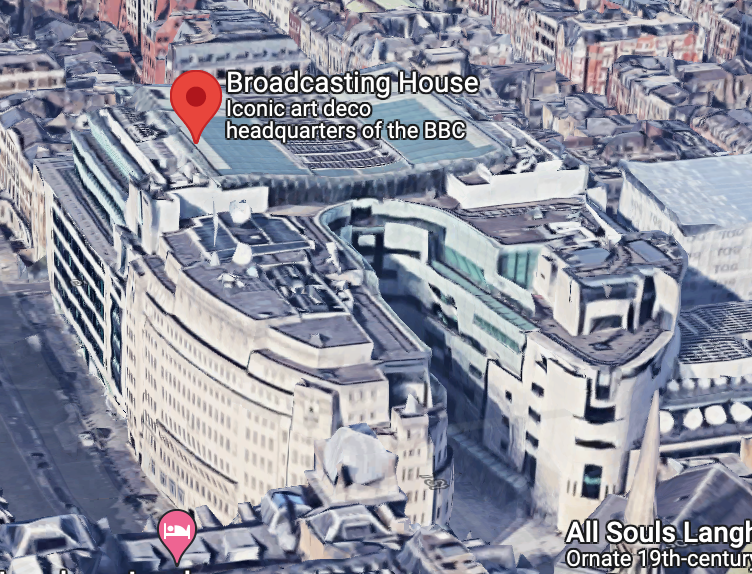
Ruth Brown, the protagonist in my Ruth Brown Mystery series, is a war correspondent during World War II. After arriving in London, she joins the hundreds of journalists from around the world in using the facilities at BBC’s Broadcasting House to write up and transmit her articles. The Art Deco structure, constructed between 1928-1932, is the organization’s first purpose-built home for radio broadcasting. 

Art Deco is defined as combining “modern styles with fine craftsmanship and rich materials. Featuring rare and expensive materials such as ebony and ivory, the style was influenced by the bold geometric forms of Cubism, the bright colors of Fauvism, the updated craftsmanship of the furniture from the eras of Louis Philip I and Louis XVI, and the exotic styles of China, Japan, India, Egypt, and Maya. 

Described by many as appearing like a ship because of the accentuated front section bearing a clock tower and aerial mast, the building is located in Portland Place and Langham Place. Nine floors tower above the street, and three floors are underground. Architect George Val Myer in collaborated with civil engineer M.T. Tudsbery to design the structure that is asymmetrical because of complaints from residents on Langham Street that the building would cast shadows on their homes cutting off natural light. The front of the structure features statues of Prospero and Ariel from Shakespeare’s The Tempest with several others of Ariel around the sides. In the foyer, a statue of “The Sower” greets staff and guests. 

When built, Broadcasting House contained twenty-two radio stations, but during WWII opened its door to British and foreign war correspondents. Unfortunately, for journalists stationed there, the building was bombed twice during the Blitz, experiencing heavy damage, several deaths, and many injuries. 

Photo: Courtesy of BBC
The first bombing occurred on October 15, 1940 and was heard live on air by listeners who had tuned in for the nine o’clock news, that night read by broadcaster Bruce Belfrage. The 225 kg (496 pounds) bomb exploded at exactly one minute and fifty seconds past the hour, but it had actually landed earlier that same evening. The level of noise and other explosions prevented anyone from realizing the device hadn’t detonated. After it was found by the defense staff, they began to evacuate the building. 

Photo: Pixabay/
Jorge Guillen
Following the incident, nearby residents made a formal complaint to the BBC that the structure was easy to sight from the sky and was being targeted by the Germans. Executive staff decided to “tone down” the building with camouflage paint, and within a month the job was complete. However, it seemed to have little effect. Just after ten o’clock in the evening on Sunday, December 8, 1940, a landmine floated down outside the entrance and exploded. There were fewer casualties but the damage was more severe than the first bombing. Afterward, the area was reinforced with a pillbox and concrete apron. During this time, a secret bomb-proof bunker was created, allowing the studios to stay on air even in the most devastating attack. 

Despite bombs falling nearby on two other occasions, Broadcasting House suffered no more damage, however, Overseas Services division and some of the domestic staff moved to temporary studios on Oxford Street. BBC Radio continued to broadcast from the roof, even during air raids.

 __________________ 

Under Fire


Set in April 1942, Under Fire, the first book in the Ruth Brown Mystery Series, tells the story of Ruth Brown whose missing sister jane is declared dead. Convinced her sister is still alive, Ruth follows clues from her small New Hampshire town to war-torn London trying to find her. Discovering that Jane has been murdered results in a faith crisis for Ruth, and she decides she must find Jane’s killer. During her search for the culprit, she runs into smugglers, resistance fighters, and the IRA, all of whom want her dead for what she knows.