Wednesday, December 29, 2021

Wartime Wednesday: Stark POW Camp

Wartime Wednesday: New Hampshire’s POW Camp 
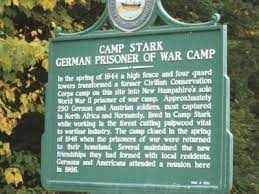
 
With a population of less than five hundred people, Stark, New Hampshire is easy to overlook. However, it was one of many American small towns transformed during World War II. Named for Revolutionary War General John Stark whose famous words “live free or die” became the state motto, Stark is located in northern New Hampshire less than fifty miles from the Canadian/US border. 
 
A paper manufacturer, The Brown Company couldn’t meet its quote of pulpwood needed for the war effort. Their number of employees had plummeted because many had enlisted, been drafted, or left the area for more lucrative positions in the defense industry. Enter Sherman Adams, a timberland manager in New Hampshire’s North Country who was about to become a congressman. He worked with U.S. Senator/Former Governor Styles Bridges to get a POW camp in place to provide workers for the paper company. Fortunately, home to a former Civilian Conservation Corp (CCC) camp, Stark already had a location that could be used that required little renovation. 
 
About 250 German and Austrian soldiers, most of whom were captured in North Africa made up the

population of the POW camp. Interesting most of the inmates were members of the 999th Division, a collection of dissidents, communists, socialists, and perceived misfits who had once been imprisoned by the Nazis. The division had been created by Hitler to give members a “chance to redeem themselves for Germany.” The men were generally older and better educated than regular German troops. Some spoke multiple languages such as French, English, Dutch, Italian, and Norwegian. They worked in the forest cutting pulpwood. 
 
By all accounts, the camp and town coexisted peacefully. Some of the guards met and married local women, and remained after the war. They were entertained at church suppers and invited into people’s homes for Sunday dinner or holidays. Eventually, the spirit of goodwill extended to the prisoners, and some of the residents brought gifts to the POWs. One of the inmates, Franz Bacher, was an artist, and he sketched pictures of the guards and painted portraits of the townspeople. Some of his artwork still hangs in the homes. 
 
Bacher later escaped from the camp and managed to remain at large for over a month. He left a note: “I am going to escape today. The reason I am doing this is I live for my art. If I continue to cut wood, my hands will become so mutilated that I will be unable to paint. If I can’t paint, I can do nothing.” Unfortunately for Bacher who was living in New York, he ran into Sergeant Ted Tausig, on a three-day leave from the prison camp. Tausig was an Austrian Jew who had escaped to America and joined the U.S. Army. The two had lived near each other in Vienna and became friends at Stark. 
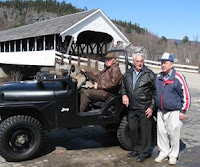
Photo: Salmon Press
Three days later, FBI agents arrested Bacher, and he was sent to Fort Devens, then Fort Eustis. The camp closed in 1946. Very little is left of the camp today, the wooden structures long dismantled, demolished, and decayed. Among the tangled and overgrown meadow can be found the crumbling fireplace-turned-memorial from the recreation hall, and the remains of one of the guard tower foundations. 

Despite being in operation for little more than two years, feelings apparently ran strong for some. In 1986, townspeople and former guards and prisoners held a reunion.
 ______________________ 

A Doctor in the House (A WWII Christmas Romance): 

They’re supposed to be allies, but mutual distrust puts this pair on opposite sides. 
 
Emma O’Sullivan is one of the first female doctors to enlist after President Franklin Roosevelt signs the order allowing women in the Army and Navy medical corps. Within weeks, Emma is assigned to England to set up a convalescent hospital, and she leaves behind everything that is familiar. When the handsome widower of the requisitioned property claims she’s incompetent and tries to get her transferred, she must prove to her superiors she’s more than capable. But she’s soon drawn to the good-looking, grieving owner. Will she have to choose between her job and her heart? 
 
Archibald “Archie” Heron is the last survivor of the Heron dynasty, his two older brothers having been lost at Dunkirk and Trondheim and his parents in the Blitz. After his wife is killed in a bombing raid while visiting Brighton, he begins to feel like a modern-day Job. To add insult to injury, the British government requisitions his country estate, Heron Hall, for the U.S. Army to use as a hospital. The last straw is when the hospital administrator turns out to be a fiery, ginger-haired American woman. She’s got to go. Or does she?

Purchase Link: https://amzn.to/3Ju7ZjY

Tuesday, December 28, 2021

Traveling Tuesday: Sugar Hill, New Hampshire

Traveling Tuesday: Sugar Hill, New Hampshire 

author photo
Sugar Hill, New Hampshire is a tiny town about ninety minutes north of where I live. Nestled in the White Mountains, the town is named for the numerous sugar maples that dot the landscape. In the late 1800s, the area became a fashionable Victorian resort after the wealthy in Boston, Hartford, New York, and Philadelphia saw the paintings by White Mountain artists that were popular at the time. Hotels and hostelries were built, and rail service arrived in 1880. By 1900, the area boasted a 9-hole golf course and clubhouse, now on the National Register of Historic Places. 
 
That same year, Robert P. Peckett, Sr. purchased landed and opened the Peckett’s-on-Sugar-Hill-Inn. Trying to increase his winter traffic, he established the first resort-based ski school in the United States. (At this point, skiing was not a well-known sport in America.) Peckett recruited two German instructors, and the school became wildly successful. He continued to bring in European instructors, including Otto Lang. Some of the more famous students of the school were Nelson Rockefeller, Averell Harriman, and Lowell Thomas. 
 
By 1939, actress Bette Davis was ready for a break from Hollywood, having just completed two films. A
native New Englander from Lowell, Massachusetts, Bette decided a trip to New Hampshire would be a good cure-all. Familiar with NH and an avid skier after many trips to Europe, she made her way to Sugar Hill where she discovered Peckett’s-on-Sugar-Hill-Inn. During her stay, she fell in love with Arthur Farnsworth, the assistant manager, and they married the following year. Tragically, he died only three years later from a fall. 
 
Bette had so much pull that she told Jack Warner she would not attend the premiere for her movie “The Great Lie” if it was held in Hollywood. Instead, she insisted the event take place in New Hampshire, at The Jax Theater in Littleton. On her 33rd birthday, thousands of locals and Hollywood stars gathered to celebrate. Proceeds from the gala went to Littleton Hospital. (Check out this clip from NH television station WMUR: https://www.wmur.com/article/monday-july-9th-the-new-hampshire-home-built-by-bette-davis/22072670#
 
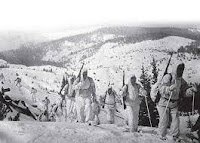
During WWII, Sugar Hill and the surrounding area would be used as training grounds for the 10th Mountain Division, the only one of its type in the military to receive intense specialized training for fighting in mountainous and arctic conditions. Made up of many young men who grew up skiing in the Northeast, the group spent much of their time in Franconia notch covering mountain travel, rock climbing techniques such as rappelling and belaying. Additionally, the hiking trails were the scenes of mock ambushes. Another aspect of their training was learning Norwegian, in the event they would be used to be sent to the fjords of Norway for an invasion. 
 
Although the grand hotels are mostly gone, Sugar Hill remains a popular location to visit year-round, and locals are still proud of their association to Bette as well as the part they played to train soldiers for the war. 

________________ 

A Doctor in the House (A WWII Christmas Romance): 

They’re supposed to be allies, but mutual distrust puts this pair on opposite sides. 
 
Emma O’Sullivan is one of the first female doctors to enlist after President Franklin Roosevelt signs the order allowing women in the Army and Navy medical corps. Within weeks, Emma is assigned to England to set up a convalescent hospital, and she leaves behind everything that is familiar. When the handsome widower of the requisitioned property claims she’s incompetent and tries to get her transferred, she must prove to her superiors she’s more than capable. But she’s soon drawn to the good-looking, grieving owner. Will she have to choose between her job and her heart? 
 
Archibald “Archie” Heron is the last survivor of the Heron dynasty, his two older brothers having been lost at Dunkirk and Trondheim and his parents in the Blitz. After his wife is killed in a bombing raid while visiting Brighton, he begins to feel like a modern-day Job. To add insult to injury, the British government requisitions his country estate, Heron Hall, for the U.S. Army to use as a hospital. The last straw is when the hospital administrator turns out to be a fiery, ginger-haired American woman. She’s got to go. Or does she?

Purchase Link: https://amzn.to/3Ju7ZjY

Wednesday, December 22, 2021

Western Wednesday: Christmas in the Old West

Western Wednesday: Christmas in the Old West 
 
Photo: public domain
Life in the Old West is sometimes romanticized, with images of Ma and Pa rocking on the front porch, kids playing in the yard. Or perhaps seated around the rustic kitchen table partaking of a nice New England pot roast dinner. For some families, that may have been true, but in the early days of settling the West, most folks had a different experience. 
 
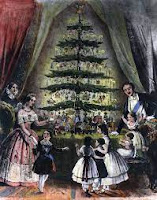
Christmas trees were popularized in the mid-1800s when Queen Victoria’s German husband brought the tradition from his homeland. Magazines picked up the story, and soon Americans embraced the practice as well. Living in the prairie where trees were scarce, most homesteaders probably didn’t put up a tree, but stockings and other decorations were popular. For those who did put up a tree, ornaments were bits of ribbon or yarn, berries, popcorn or paper strings, and other homemade decorations. 
 
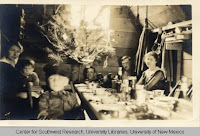
The holiday meal was a big deal, and women pulled out all the stops to create a feast. Their husbands
Photo: UNM Archives
went hunting for game, while they baked bread and sweets as well as brought out preserved fruits and vegetables. Plum pudding would have been prepared well ahead to allow it time to age before Christmas dinner. 
 
Gifts would have been simple and primarily homemade, either because of the financial situation of the family or the lack of items available. Cornhusk or rag dolls for little girls, carved wooden toys, embroidered hankies, pillows, scarves, hats, mittens, and socks would be worked on during the year. If the family had a successful year, children might also find candy and other store-bought goodies in their stockings. 
 
Photo: WikiImages

Christmas eve traditions differed for each family, but many would gather to sing carols around the fireplace. On Christmas Day, most would head to church for a special service, then return home for the big meal and opening of presents. Afterward, if the weather was fine, they would travel around the community visiting with friends and neighbors. 
 
Wishing you a blessed Christmas and Happy New Year! 


____________________________
 
A Doctor in the House: A Christmas Romance

They’re supposed to be allies, but mutual distrust puts this pair on opposite sides. 
 
Emma O’Sullivan is one of the first female doctors to enlist after President Franklin Roosevelt signs the order allowing women in the Army and Navy medical corps. Within weeks, Emma is assigned to England to set up a convalescent hospital. She leaves behind everything that is familiar and arrives in the unfamiliar country a short time before Christmas. When the handsome widower of the requisitioned property claims she’s incompetent and tries to get her transferred, she must prove to her superiors she’s more than capable. But she’s soon drawn to the good-looking, grieving owner. Will she have to choose between her job and her heart? 
 
Archibald “Archie” Heron is the last survivor of the Heron dynasty, his two older brothers having been lost at Dunkirk and Trondheim and his parents in the Blitz. After his wife is killed in a bombing raid while visiting Brighton, he begins to feel like a modern-day Job. To add insult to injury, the British government requisitions his country estate, Heron Hall, for the U.S. Army to use as a hospital. The last straw is when the hospital administrator turns out to be a fiery, ginger-haired American woman. She’s got to go. Or does she?

Purchase Link: https://amzn.to/3E9HVXb

Monday, December 20, 2021

Mystery Monday: Who was Cyril Hare

Mystery Monday: Who was Cyril Hare?

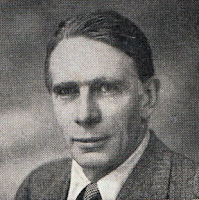
Despite being one of the prolific authors from the Golden Age of Detective Fiction, Cyril Hare has been largely forgotten by the reading public. A combination of Hare Court (where he worked) and Cyril Mansion (where he lived), the name is a pseudonym for Alfred Alexander Gordon Clark, who was born on September 4, 1900. His family was part of the Matthew Clark & Sons drink distribution company founded in 1810. 
 
Clark was educated at St. Aubyn’s, then Oxford where he graduated with a First. He studied law and entered the Bar in 1924. Nine years later he married Mary Barbara Lawrence, daughter of Sir William Lawrence, 3rd Baronet, horticulturalist, hospital administrator, and collector. They had three children, a son and two daughters, all of whom were very successful. 
 
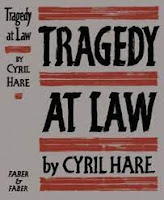
At some point in the 1930s, Clark began penning mystery stories. The first, Tenant for Death, a story he adapted from a stage play he’d written, was published in 1937. That same year he also published a short story titled The Death of Amy Robsart. He published another novel and some short stories, but his breakout success came in 1942 with the publication of Tragedy at Law
 
Most scholars feel he based the plotline on his experiences during WWII when he toured as a judge’smarshal. He worked for the Director of Public Prosecution as well as serving with the Ministry of Economic Warfare. His wartime job must have kept him exceptionally busy because Clark wouldn’t publish another novel until 1946: With a Bare Bodkin
 
In 1950, he was appointed a county court judge in Surrey but managed to continue writing with regularity, publishing three to five short stories per year, mostly for "The Evening Standard." Tragedy at Law has never been out of print and has been praised by critics and authors as being among the best legal whodunits ever written. All in all, Clark published ten novels, forty short stories, one radio play, and two stage plays. 
 
Because of a bout with tuberculosis during WWII, his health suffered, and he passed away August 25, 1958, ten days before his 58th birthday. 

Have you ever heard of Cyril Hare? 

___________________________

Murder at Madison Square Garden 

The dream of a lifetime becomes a nightmare. 
 
Photojournalist Theodora “Teddy” Schafer’s career has hit the skids thanks to rumors of plagiarism. With any luck, a photo spread with Charles Lindbergh at the America First Rally will salvage her reputation. After an attempted assassination of Lindbergh leaves another man dead, Teddy is left holding the gun. Literally. Can she prove her innocence before the police lock her up for a murder she didn’t commit? 
 
Private Investigator Ric Bogart wants nothing to do with women after his wife cleaned out their bank account and left him for another man, but he can’t ignore the feeling he’s supposed to help the scrappy, female reporter who is arrested for murder at the America First rally. Can he believe her claims of innocence and find the real killer without letting Teddy steal his heart?

Purchase Link: https://amzn.to/3mcTXcs

Friday, December 17, 2021

Fiction Friday: A Blast from the Past

Fiction Friday: A Blast from the Past

Photo: Pixabay/
DariuszSankowski

Part of my research process is to read books from the time period in which my story is set. My next project is a series of books set during the 1880s. Here are just a few of the publications from that decade: 

Ben Hur by Lew Wallace: Published in 1880, the story tells the adventures of Judah Ben-Hur, a Jewish prince who is enslaved by the Romances at the beginning of the first century. A parallel narrative is the story of Jesus, who was from the same region and around the same age. The book became a bestseller and is considered one of the most influential Christian books of the nineteenth century. 

The Adventures of Robin Hood by Howard Pyle: Published in 1883, this novel consists of a series of episodes, compiling traditional material into a narrative using invented “Old English” idiom. The book is credited with influencing later authors, artists, and filmmakers. 

A Connecticut Yankee in King Arthur’s Court by Mark Twain: Published in 1889,
the book is about Yankee engineer Hank Morgan who receives a blow to the head and is somehow transported in time and space to England during the reign of King Arthur. Hank uses his knowledge to make people believe he’s a magician and tries to modernize the past. In the end, he is unable to prevent the death of Arthur. 
 
The Strange Case of Dr. Jekyll and Mr. Hyde by Robert Louis Stevenson: Published in 1886, the book is about a London legal practitioner who investigates the strange occurrences between his old friend Dr. Henry Jekyll and the evil Edward Hyde. The impact of the novella is such that the phrase Jekyll and Hyde is known to refer to people with an unpredictably dual nature. 
 
The Man Who Would Be King by Rudyard Kipling: Published in 1888, the story is narrated by a British Indian journalist, correspondent of The Northern Star, in nineteenth-century India (Kipling himself in all but name), and tells of the adventures of two British young men who become kings of Kafiristan, a remote part of Afghanistan.  

A Study in Scarlet by Arthur Conan Doyle
: Published in 1887, the detective novel marks the first appearance of Sherlock Holmes and Dr. Watson. The title comes from a speech given by Holmes during which he says, “There’s a scarlet thread of murder running through the colorless skein of life, and our duty is to unravel it, and isolate it, and expose every inch of it.” The story and its characters attracted little public interest when it first appeared. 
 
Which of these classics have you read? 

___________________

Legacy of Love (On tour and on sale!)

Will their love come at a cost? 

Escaping Boston to avoid a marriage of convenience aimed at garnering society’s respect for her family name in the shadow of her father’s war profiteering, Meg Underwood settles in Spruce Hill, Oregon. Despite leaving behind the comforts of wealth, she’s happy. Then the handsome Pinkerton agent, Reuben Jessop, arrives with news that she’s inherited her aunt’s significant estate, and she must return home to claim the bequest. Meg refuses to make the trip. Unwilling to fail at his mission, Reuben gives her until Christmas to prove why she should remain in Spruce Hill and give up the opportunity to become a woman of means. When he seems to want more than friendship, she wonders if her new-found wealth is the basis of his attraction.

Purchase Link:  https://amzn.to/31KOAdA

Thursday, December 16, 2021

Talkshow Thursday: Welcome back, Sami Abrams!

Talkshow Thursday: Welcome back, Sami Abrams

Linda: Welcome back to my blog, and congratulations on your upcoming debut novel, Buried Cold Case Secrets. What was your inspiration for the story? 

Sami: Buried Cold Case Secrets was born during MurderCon. Sounds menacing, doesn’t it? Lol! MurderCon is part of the Writer’s Police Academy, a conference for authors to learn from law enforcement specialists. During this conference, I went to a forensic anthropology workshop and Melanie’s character took shape. 

LM: How did the opportunity to write for Love Inspired come about? Sami: My agent Tamela Hancock Murray encouraged me to submit to Love Inspired Suspense, and I met two different editors at the ACFW conferences that asked for manuscripts. So, I decided to give it a shot and here we are. 😊 

LM: Research is an important part of writing. What sort of research did you do for Buried Cold Case Secrets? Was there any sort of “aha” tidbit you found that you knew needed to be included? 

Sami: I’m always asking my law enforcement consultant if something is plausible. So there’s that. But I
think for this one I go back to the antifreeze poisoning. I had to make sure the symptoms were correct and have a way of counteracting it. I’m not sure it was an “aha” moment, but it was definitely interesting. 

LM: What authors influenced your writing? 
 
ami: Oh my, now that’s a loaded question. Lol! I’d have to say that the two authors that most influence my writing are Virginia Vaughan and Lynette Eason. Which comes in handy since they both mentor me on different projects. Virginia with my Love Inspired Suspense, and Lynette with my Elite Guardians Collection through Sunrise Publishing. 😊 

LM: In addition to writing, you are part of the Suspense Squad, a group of authors who interview other authors and hold topical discussions. How do you juggle your many responsibilities? 

Sami: The Suspense Squad is a great group. We love to have fun and can get quite silly at times. It’s a nice break from work when we are together. As for how do I juggle all my responsibilities…I’m a planner. (You notice I didn’t say plotter. Hehe!) My husband calls my calendar “the decade at a glance.” So, as long as it’s on my calendar and I’m not overbooked, all is good. 

LM: What is one thing you wish you knew how to do? 

Sami: Oh, there are so many things I wish I could do. But, I think my top two (sorry, there’s more than one. 😊)…I wish I knew how to draw. And the other, I wish I knew how to speak different languages. 

LM: What is your next project? 

Sami: I’m currently working on revisions for my Elite Guardians Collection novel with Lynette Eason and Sunrise Publishing which should release in June 2022. In addition, I have another Love Inspired Suspense releasing September 2022. Twin Murder Mix-up, book 2 in the Deputies of Anderson County series, will go on sale August 23, 2022. 

LM: Where can folks find you on the web? 

Sami: People can find me at http://www.samiaabrams.com. I’d love for everyone to sign up for my newsletter so we can stay in touch. 

About Buried Cold Case Secrets

Recovering her missing memories could be the key to solving a murder Searching for her best friend’s remains could help forensic anthropologist Melanie Hutton regain her memories of when they were both kidnapped—unless the killer gets to Melanie first. For her safety, Melanie must rely on Detective Jason Cooper, who still blames her for his sister’s death. Can Jason set the past aside to solve the cold-case murder…and shield Melanie from the same fate?

Purchase Link: https://amzn.to/3HKRU8A

Tuesday, December 14, 2021

Traveling Tuesday: U.S. Territories

Traveling Tuesday: U.S. Territories


Photo: Pixabay/CCPapa
How good is your knowledge of U.S. territories? Until recently, mine was scant at best. Most of the continental United States began as various territories that were either purchased or taken in conquest between the late 1700s and late 1800s. But during our nation’s history, the country purchased an island and obtained others as spoils of war. 
 
Currently, the U.S. administers fourteen territories; five of which are permanently inhabited (Guam, Puerto Rico, American Samoa, Northern Mariana Islands, and U.S. Virgin Islands). The other nine are not inhabited and include four islands, two atolls, one reef, and one collection of islands. Territories are classified by incorporation and whether they have an “organized” government through an act passed by Congress. Territories are under U.S. sovereignty and may be treated as part of the United States proper in some ways and not in others. The Constitution applies only partially in unincorporated territories. 
 
Territories were generally created to administer newly acquired land, and most
Photo: Pixabay/AndPond
eventually attained statehood, however, others such as the Philippines, Palau, and the Marshall Islands became independent. Residents of territories cannot vote in U.S. Presidential elections, and they have only non-voting representation in Congress. With the exception of Puerto Rico, the territories are administered by the Office of Insular Affairs (part of the U.S. Department of the Interior). 
 
Photo: Pixabay/inactionsolutions
Each territory is self-governing with three branches of government, including a locally elected governor and territorial legislature. Interestingly, people born in Puerto Rico, the U.S. Virgin Islands, Guam, and the Northern Mariana Islands are U.S. citizens by birth, however, people in American Samoa acquire U.S. nationality but not citizenship by birth if they don’t have a U.S. citizen parent. In order to gain citizenship, Samoans must reside in parts of the U.S. (other than American Samoa) and apply for naturalization. 

  • Puerto Rico: Acquired at the end of the Spanish-American War (1899), and has been a U.S. Commonwealth since 1952. 
  • Guam: Acquired at the end of the Spanish-American War (1899). U.S. citizenship was granted in 1950. The island is the home of the Naval Base Guam and Andersen Air Force Base. 
  • American Samoa: A territory since 1900 after the end of the Second Samoan Civil War. The islands were divided into two regions, and the U.S took control of the eastern half of the island. 
  • U.S. Virgin Islands: Purchased from Denmark in 1917. U.S. citizenship was granted in 1927. The main islands are St. Thomas, St. John, and St. Croix.
  • Northern Mariana Islands: The islands became part of the United Nations Trust Territory of the Pacific islands in 1947, administered by the U.S. as a U.N Trustee. Failed attempts to reunify Guam and the Marianas in the 1950s and 1960s, resulted in a covenant that established the Northern Mariana Islands as a commonwealth that was approved in 1975 and came into force in 1976. In 1986, the Islands formally left U.N. Trusteeship. 
 
Have you visited any of the U.S. territories? 

__________________ 

Legacy of Love (on tour and on sale!)

Will their love come at a cost? 
 
Escaping Boston to avoid a marriage of convenience aimed at garnering society’s respect for her family name in the shadow of her father’s war profiteering, Meg Underwood settles in Spruce Hill, Oregon. Despite leaving behind the comforts of wealth, she’s happy. Then the handsome Pinkerton agent, Reuben Jessop, arrives with news that she’s inherited her aunt’s significant estate, and she must return home to claim the bequest. Meg refuses to make the trip. Unwilling to fail at his mission, Reuben gives her until Christmas to prove why she should remain in Spruce Hill and give up the opportunity to become a woman of means. When he seems to want more than friendship, she wonders if her new-found wealth is the basis of his attraction. 

Purchase Link: https://amzn.to/31KOAdA