Showing posts with label #newhampshire. Show all posts

Tuesday, April 15, 2025

Traveling Tuesday: Grand Hotels of New Hampshire

Traveling Tuesday: 
Grand Hotels in New Hampshire


The Gilded Age brought prosperity to America, and during the era, hundreds of “grand hotels’ sprang up across the country offering luxury and service to the rich and famous. You may be familiar New York’s Waldorf Astoria, Washington, DC’s Willard InterContinental, and The Grand Hotel on Mackinac Island, Michigan. Tragically, some of the grand hotels were vacated and eventually fell into disrepair to be knocked down and forgotten.

Of the original twenty-four grand hotels in New Hampshire four are still in operation: Mt. Washington Hotel, The Wentworth Inn, Eagle Mountain House, and The Mountain View Grand. The Balsams, built in 1866, is currently closed with plans to reopen in the future. All the hotels are in the northern part of the state in the White Mountains.

The Mt. Washington Hotel was built in Bretton Woods between 1900 and 1902 by NH native Joseph Stickney whose wealth came from being a coal broker. With an eye toward creating a luxurious getaway for “city folks,” he spared no expense, spending $1.7 million (approximately $64 million in today’s dollars). According to Wikipedia, at its completed the hotel had more than 2,000 doors, 12,000 windows, and eleven miles of plumbing. Unfortunately for Stickney, he died of a heart attack the year after the hotel opened. His wife spent summers at the hotel and continued to expand the structure.

Constructed in 1869 in the town of Jackson by Joshua Trickey and originally names the Thorn
Mountain House, the Wentworth Inn was a wedding gift for his daughter, Georgia, and her husband, General Marshall Clark Wentworth. By the turn of the century the facility included a casino, multiple billiard parlors, and a ballroom. Eventually, the inn grew to its current size of sixty-one rooms. Not much is known about Trickey other than he had a successful farm, and built the Jackson Falls House (hotel) in 1858, then two years later, sold some of his property to the school district so they could build the schoolhouse.

Opening in 1879, Eagle Mountain House had rather humble beginnings. The original inn was a farmhouse style building that could accommodate twelve guests, and the owners worked the surrounding property as a farm, providing food for the guests from their fields. A golf course went in sometime prior to 1910 because the sport was all the rage by this time. Two more buildings were added allowing for up to 125 guests, but tragically a fire in 1915 destroyed the Main Inn. The new building with seventy-five rooms, most featuring private baths, was completed the following year. An elevator was also installed.

The Mountain View Grand was originally known as the Mountain View House and opened in 1866 by William and Mary Jane Dodge. Intriguingly, the hotel was not a hotel when the first guests arrived. The story goes that after a stagecoach overturned on a stormy night in 1865, the passengers made their way to the Dodge’s house and asked if they could stay the night. They were served a full breakfast the following morning and requested to stay longer. The Dodges agreed. Before leaving the guests asked if they could come back the following summer, and the Dodges realized they had something special. By the following year they had expanded the property and opened officially. Over the years, additions were made with a final total of 141 rooms. The guest book reads like a who’s who with seven presidents, writers such as Robert Frost, Ralph Waldo Emerson, and Steven King, and film stars that included Betty Grable, Bette Davis, and the Marx Brothers.

Have you ever stayed in a “grand” hotel?
___________________

Ivy's Inheritance

Has she fled one untrustworthy man only to be stuck with another?


Ivy Cregg’s father is a gambler, but this time he’s gone too far. He loses his mining fortune and her along with it in a high-stakes poker game. Unwilling to go along with the deal, she hides out with a friend who tells her about Ms. Crenshaw, owner of the Westward Home & Hearts Mail-Order Bride Agency who is in town. The prospective groom is a wealthy man which seems like an answer to prayer until Ivy discovers he made his fortune in mining. Is he as untrustworthy as her father?

After emigrating to America to fight for the Union during their Civil War, Slade Pendleton moved West while working on the railroad, then headed to the plains of Nebraska to seek his fortune. He was one of the lucky ones and now has everything he could ever want. Except a wife. With the few women in the town already married, he sends for a mail-order bride. The woman arrives carrying the telegram that explains her need to flee, but now that she’s safe, she seems to have no interest in going through with the ceremony. Should he send her packing or try to convince her to stay?

Purchase Link: https://amzn.to/3Ca3xI6

Photo Credits: 
Mountain Washington Hotel: By rickpilot_2000 from Hooksett, USA - Mt. Washington HotelUploaded by jbarta, CC BY 2.0, https://commons.wikimedia.org/w/index.php?curid=26447136 

Wentworth Inn: Courtesy of the Wentworth Inn

The Mountain View Grand: Courtesy of visitwhitemountains.com


Thursday, December 14, 2023

Talkshow Thursday: Welcome back, Kathleen Bailey!

Talkshow Thursday: 
Welcome back, Kathleen Bailey!

December marks the observed birth of my Savior (of course), my umpteenth appearance on this blog (thanks Linda!) and a couple of firsts: my first novel with Elk Lake Publishing and my first contemporary Christian Christmas romance. There’s a lot to celebrate. Here’s how the book came to be:

For many years our family enjoyed a Christmas festival in the next town over. It was unabashedly “Christmas,” not “Holiday” or “Jingle Bell” or “Winter Solstice.” Though a local church sponsored the event, the town joined in, providing security and allowing the festival to use the old library, old schoolhouse, and other town buildings. Any funds raised went into a separate festival account, and the church didn‘t receive a dime. It was a collaboration between church and state I never saw before or since.

“Lights on the Hill” fell victim to COVID-19 and a dearth of volunteers. But by then I had the germ of a story and a series. I asked the traditional writers’ questions, “What if” and “why not?”

WHAT IF…a small town held an annual Christmas festival that was more than the sum of its parts?
Pixabay/Michelle Rapponi
What if estranged children came back to their parents and to Christ during the event, what if warring couples reconciled? What if old hurts were banished over a bowl of soup or a sleigh ride?

The “what if” became the foundation for Hilltop, my small town series, and its slogan: “Welcome to Hilltop, the Town That Heals.”

But I still needed people for Hilltop to heal. WHAT IF…a young woman came home to Hilltop, to run the festival for her convalescing grandmother, even though she’d avoided Hilltop, and religion since she left town for college? WHAT IF…the new pastor, a California misfit in this snowy hamlet, decided to make her conversion his personal project? WHY NOT…throw them together on the festival planning, and have God and the festival do the rest?

Pixabay/bethb1036
I had so much fun with this one. The New Hampshire mountains are a treasure for anyone who lives here or wishes they did. I was able to incorporate the Kancamagus Highway, the spot where the Old Man of the Mountains stood, the town of Littleton and more. I wrote about places that have been special to me since childhood. And I was able to create my own quirky small town, with flinty, funny New England characters.

So this Christmas season, why not join me in Hilltop? Have a doughnut at the French Hens Bakery, attend the fish fry at the Limelighter Café, take a sleigh ride or toast a marshmallow or listen to the carols pealing from the carillon.

Welcome to Hilltop. We’re glad you’re here.

About A Hilltop Christmas

When Jane Archer comes home to tiny Hilltop, New Hampshire, her goal is to take care of her convalescing grandmother and get back to Boston as soon as possible. She doesn’t expect to be saddled with the direction of the Hilltop Christmas Festival, three days of activities exalting the birth of a God she no longer serves. But Gram asks her to take over the Festival this year, and she can’t say no to the woman who saved her life.

The Rev. Noah Hastings didn’t want to come to Hilltop in the first place. Too small, too cold for this California boy. And he has trouble figuring out these Yankees, with their “thin sharp faces and sharper wits.” It’s his first church, and his goal is to amass some “ministerial brownie points” and be out of there. But his early life with his father has left Noah with damaged confidence, and despite his call, he’s not sure he can handle a pastorate, let alone Jane Archer.

Though the people of Hilltop have never stopped loving her, coming home reawakens memories for Jane of a childhood no child should have to live through. She feels her carefully constructed world crumbling, even as she resists the pull of Christ on her life.

But when the integrity of the Festival is threatened, Noah must call on his Lord, and Jane on the God from whom she's drifted, to find justice and restore Hilltop to what it is.

Purchase Link: https://amzn.to/3FJdsCS

Wednesday, December 29, 2021

Wartime Wednesday: Stark POW Camp

Wartime Wednesday: New Hampshire’s POW Camp 
 
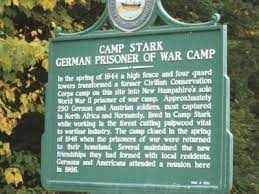
With a population of less than five hundred people, Stark, New Hampshire is easy to overlook. However, it was one of many American small towns transformed during World War II. Named for Revolutionary War General John Stark whose famous words “live free or die” became the state motto, Stark is located in northern New Hampshire less than fifty miles from the Canadian/US border. 
 
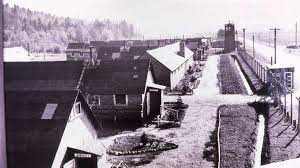
A paper manufacturer, The Brown Company couldn’t meet its quote of pulpwood needed for the war effort. Their number of employees had plummeted because many had enlisted, been drafted, or left the area for more lucrative positions in the defense industry. Enter Sherman Adams, a timberland manager in New Hampshire’s North Country who was about to become a congressman. He worked with U.S. Senator/Former Governor Styles Bridges to get a POW camp in place to provide workers for the paper company. Fortunately, home to a former Civilian Conservation Corp (CCC) camp, Stark already had a location that could be used that required little renovation. 
 
About 250 German and Austrian soldiers, most of whom were captured in North Africa made up the
population of the POW camp. Interesting most of the inmates were members of the 999th Division, a collection of dissidents, communists, socialists, and perceived misfits who had once been imprisoned by the Nazis. The division had been created by Hitler to give members a “chance to redeem themselves for Germany.” The men were generally older and better educated than regular German troops. Some spoke multiple languages such as French, English, Dutch, Italian, and Norwegian. They worked in the forest cutting pulpwood. 
 
By all accounts, the camp and town coexisted peacefully. Some of the guards met and married local women, and remained after the war. They were entertained at church suppers and invited into people’s homes for Sunday dinner or holidays. Eventually, the spirit of goodwill extended to the prisoners, and some of the residents brought gifts to the POWs. One of the inmates, Franz Bacher, was an artist, and he sketched pictures of the guards and painted portraits of the townspeople. Some of his artwork still hangs in the homes. 
 
Bacher later escaped from the camp and managed to remain at large for over a month. He left a note: “I am going to escape today. The reason I am doing this is I live for my art. If I continue to cut wood, my hands will become so mutilated that I will be unable to paint. If I can’t paint, I can do nothing.” Unfortunately for Bacher who was living in New York, he ran into Sergeant Ted Tausig, on a three-day leave from the prison camp. Tausig was an Austrian Jew who had escaped to America and joined the U.S. Army. The two had lived near each other in Vienna and became friends at Stark. 

Photo: Salmon Press
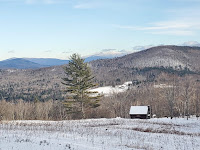
Three days later, FBI agents arrested Bacher, and he was sent to Fort Devens, then Fort Eustis. The camp closed in 1946. Very little is left of the camp today, the wooden structures long dismantled, demolished, and decayed. Among the tangled and overgrown meadow can be found the crumbling fireplace-turned-memorial from the recreation hall, and the remains of one of the guard tower foundations. 

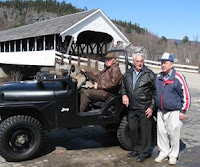
Despite being in operation for little more than two years, feelings apparently ran strong for some. In 1986, townspeople and former guards and prisoners held a reunion.
 ______________________ 

A Doctor in the House (A WWII Christmas Romance): 

They’re supposed to be allies, but mutual distrust puts this pair on opposite sides. 
 
Emma O’Sullivan is one of the first female doctors to enlist after President Franklin Roosevelt signs the order allowing women in the Army and Navy medical corps. Within weeks, Emma is assigned to England to set up a convalescent hospital, and she leaves behind everything that is familiar. When the handsome widower of the requisitioned property claims she’s incompetent and tries to get her transferred, she must prove to her superiors she’s more than capable. But she’s soon drawn to the good-looking, grieving owner. Will she have to choose between her job and her heart? 
 
Archibald “Archie” Heron is the last survivor of the Heron dynasty, his two older brothers having been lost at Dunkirk and Trondheim and his parents in the Blitz. After his wife is killed in a bombing raid while visiting Brighton, he begins to feel like a modern-day Job. To add insult to injury, the British government requisitions his country estate, Heron Hall, for the U.S. Army to use as a hospital. The last straw is when the hospital administrator turns out to be a fiery, ginger-haired American woman. She’s got to go. Or does she?

Purchase Link: https://amzn.to/3Ju7ZjY

Tuesday, December 28, 2021

Traveling Tuesday: Sugar Hill, New Hampshire

Traveling Tuesday: Sugar Hill, New Hampshire 

author photo
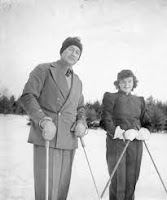
Sugar Hill, New Hampshire is a tiny town about ninety minutes north of where I live. Nestled in the White Mountains, the town is named for the numerous sugar maples that dot the landscape. In the late 1800s, the area became a fashionable Victorian resort after the wealthy in Boston, Hartford, New York, and Philadelphia saw the paintings by White Mountain artists that were popular at the time. Hotels and hostelries were built, and rail service arrived in 1880. By 1900, the area boasted a 9-hole golf course and clubhouse, now on the National Register of Historic Places. 
 
That same year, Robert P. Peckett, Sr. purchased landed and opened the Peckett’s-on-Sugar-Hill-Inn. Trying to increase his winter traffic, he established the first resort-based ski school in the United States. (At this point, skiing was not a well-known sport in America.) Peckett recruited two German instructors, and the school became wildly successful. He continued to bring in European instructors, including Otto Lang. Some of the more famous students of the school were Nelson Rockefeller, Averell Harriman, and Lowell Thomas. 
 
By 1939, actress Bette Davis was ready for a break from Hollywood, having just completed two films. A
native New Englander from Lowell, Massachusetts, Bette decided a trip to New Hampshire would be a good cure-all. Familiar with NH and an avid skier after many trips to Europe, she made her way to Sugar Hill where she discovered Peckett’s-on-Sugar-Hill-Inn. During her stay, she fell in love with Arthur Farnsworth, the assistant manager, and they married the following year. Tragically, he died only three years later from a fall. 
 
Bette had so much pull that she told Jack Warner she would not attend the premiere for her movie “The Great Lie” if it was held in Hollywood. Instead, she insisted the event take place in New Hampshire, at The Jax Theater in Littleton. On her 33rd birthday, thousands of locals and Hollywood stars gathered to celebrate. Proceeds from the gala went to Littleton Hospital. (Check out this clip from NH television station WMUR: https://www.wmur.com/article/monday-july-9th-the-new-hampshire-home-built-by-bette-davis/22072670#
 
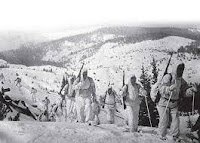
During WWII, Sugar Hill and the surrounding area would be used as training grounds for the 10th Mountain Division, the only one of its type in the military to receive intense specialized training for fighting in mountainous and arctic conditions. Made up of many young men who grew up skiing in the Northeast, the group spent much of their time in Franconia notch covering mountain travel, rock climbing techniques such as rappelling and belaying. Additionally, the hiking trails were the scenes of mock ambushes. Another aspect of their training was learning Norwegian, in the event they would be used to be sent to the fjords of Norway for an invasion. 
 
Although the grand hotels are mostly gone, Sugar Hill remains a popular location to visit year-round, and locals are still proud of their association to Bette as well as the part they played to train soldiers for the war. 

________________ 

A Doctor in the House (A WWII Christmas Romance): 

They’re supposed to be allies, but mutual distrust puts this pair on opposite sides. 
 
Emma O’Sullivan is one of the first female doctors to enlist after President Franklin Roosevelt signs the order allowing women in the Army and Navy medical corps. Within weeks, Emma is assigned to England to set up a convalescent hospital, and she leaves behind everything that is familiar. When the handsome widower of the requisitioned property claims she’s incompetent and tries to get her transferred, she must prove to her superiors she’s more than capable. But she’s soon drawn to the good-looking, grieving owner. Will she have to choose between her job and her heart? 
 
Archibald “Archie” Heron is the last survivor of the Heron dynasty, his two older brothers having been lost at Dunkirk and Trondheim and his parents in the Blitz. After his wife is killed in a bombing raid while visiting Brighton, he begins to feel like a modern-day Job. To add insult to injury, the British government requisitions his country estate, Heron Hall, for the U.S. Army to use as a hospital. The last straw is when the hospital administrator turns out to be a fiery, ginger-haired American woman. She’s got to go. Or does she?

Purchase Link: https://amzn.to/3Ju7ZjY