Thursday, November 3, 2022

Talkshow Thursday: Chatting with Crystal Caudill

Talkshow Thursday: Chatting with Crystal Caudill

LM: Thanks for joining me today. Congratulations on your upcoming release Counterfeit Hope. (Hidden Hearts of the Gilded Age, Book 2) What was your inspiration for the story, and did you set out to write a series?

Crystal: If it is okay, I’m going to flip the order of those questions. My brain tends to think of stories in sets of three, so yes, I’ve always intended this to be a series. As far as the inspiration for Counterfeit Hope, there are two things that lead to this story. First, it started with a scene that just appeared in my head of an undercover operative being forced into a marriage with a criminal. It wasn’t until I discovered a bit of counterfeiting research about a gang that had taken over part of Indiana that everything really came together. There are lots of little details in my story that are nods to the real case that inspired the full plot of Counterfeit Hope.

LM: What sort of research did you do for the book, and was there a particularly intriguing piece of information you knew had to be included?

Crystal: I’m a total research nerd. I spent a lot of time reading newspapers from that time frame with a focus on articles related to counterfeiting. That’s how I discovered the story about a Secret Service operative who went undercover as a traveling nostrum doctor in order to infiltrate and arrest the Houchin gang in Pike County, Indiana in 1883. It really formed the basis for the story, even though I didn’t follow that exactly. But I HAD to keep that Andrew Darlington passed himself off as a traveling nostrum, and like Andrew’s medicine did actually have some success, so did the original operative’s.

LM: How did writing the second book differ from the first? How was it the same?

Crystal: I really learned how to write with my first book, Counterfeit Love. It was a slow, laborious process that took years. When it came to book two, I didn’t have that luxury. I tried my hand at plotting to see if that could speed things up, but I discovered that really detailed plotting just doesn’t work for me. I get to about the ¼ to 1/3 mark and my characters crumple that plot in their hands, laugh in my face, and then toss it in the fire before running off to do what THEY think the story should be. And they’re usually right. So while there was still quite a bit of pantsing going on, I did have a general idea of the story and wrote this book a lot quicker than the first—which is a good thing since I was on deadline.

LM: Tell us about your road to publication.

Crystal: I want to start off by saying, no one’s road is the same because God has a unique plan for each
Pixabay/Larisa Koshkina
of us. That being said, I never wanted to be a published author. I loved writing stories for myself, but I had no desire to send my book babies into the world. But as is usually the case, God had other plans. I’ve always loved to learn and improve myself, and my husband sent me to a local writing conference for a major birthday. It was there that God made it abundantly clear (quite forcefully I might add) that I was to pursue this publishing journey. 

He did this first through Ralene Burke introducing me to this organization called American Christian Fiction Writers (ACFW). Then Ralene introduced me to Gregg Bridgeman who very bluntly indicated that God had given me this gift of writing for a reason. I’m stubborn, so I just nodded and ran away as quickly as possible. Then God managed to cancel all but one of the writing craft classes I wanted to attend and forced me to attend two or three different publishing classes. I left there knowing what God was calling me to do, but I fought Him for six months before joining ACFW to begin the journey. If I was going to do this, I was going to do it right—through a ton of education before I ever submitted to anyone. 

I spent the next four or five years learning from lots of great teachers and authors. I won’t bore you with all the details, but when I felt God pushing me to take the next step and submit to an agent, I met with two agents at an ACFW Conference. Instead of pitching my book, I asked them questions to determine if we’d be a good fit, and then did a rushed pitch in the last two minutes. They both requested me to submit to them (which I think was them just being nice), and I decided I would only do one at a time. I was blessed in that the first agent, Tamela Hancock Murray, signed me on. We submitted Counterfeit Love to lots of places. Most were quick rejections, and then it was dead silence for a year. When we finally decided to shelve it and I started working on another project, that’s when I got the call from her that Kregel wanted my book. It’s been a whirlwind ever since.

LM: What is it about this era that draws you?

Crystal: The Gilded Age is so multilayered and rich with history. When most people think Gilded Age, they think of the uber-rich like the Astors and the “Four Hundred.” However, it was much more than that, and rife with political upheaval, social change, labor riots, gigantic leaps in technology, and so much more. I just love the complexity of it all and showing the underbelly of that gilded world. The term Gilded Age actually came as a sarcastic remark from Mark Twain in his novel by the same name, and was reflective of the United States at that time. It looked all glittery and fine from the outside, but if you scratched beneath the surface, you’d find greed and corruption. It’s the perfect playground for setting novels.

LM: You’ve accomplished quite a lot. What is one thing you wish you could do?

Crystal: Honestly, learn to balance and find rest. I’m also a caregiver so I feel like every moment of my day is either taken up with writing or figuring out the nuances of our new normal—which changes without warning frequently. It’s a wearying pace, and I am working on creating rest in my life, so that I can live for the glory of God the best way I can. Writing-wise? I’d love to make writing a career and continuously improve with each book.

LM: What is your advice to fledgling writers?

Crystal: Learn the craft and don’t be too eager to just get your book out there. Writing is a journey, one that takes a lot of time, looks different for each person, and is meant to draw you ever nearer to God. Be patient. Study. Study. Study. Write. Write. Write. Take classes from those who have successfully gone before you, and don’t submit anything to anyone until you think you have reached the best you can be on your own. You never stop growing, but there does come a point where you need the influence and help of those around you to grow beyond what you ever imagined you’d be. Also, and definitely the most important, never stop seeking God through this process. This is a knock-out beat-you-down industry. You need to be able to lean into God on those hard days and even the good ones.

LM: What is your next project?

Pixabay/Enrique
Crystal: I’ve actually got two books already written with Kregel and going through the editing process. Counterfeit Faith, book 3, will release in 2024, and a yet unnamed novella in the We Three Kings Christmas collection will release fall 2023. Currently, I’m brainstorming a new series to pitch to Kregel later this month that has some cross-over characters from Counterfeit Love but deals with three women finding their place in a man’s world amidst lots of danger and art. For now, I’m calling the series The Art of Love and Danger.

LM: Where can folks find you on the web?

Crystal: If you want the inside information on my life, publishing, Secret Service trivia, and even a free Hidden Hearts of the Gilded Age novella called Counterfeit Truth, you can sign up for my newsletter at bit.ly/CaudillNews. Everything else is listed below for easy reference.

Website:  https://crystalcaudill.com/ (Author & Character interviews, book reviews, and monthly book challenge with prizes)
Newsletter: bit.ly/CaudillNews (Free novella, see above)
Facebook: https://www.facebook.com/crystalcaudillauthor
Facebook Group: https://www.facebook.com/groups/crystalcaudillsreadingfriends (This is where I hang on a day-to-day basis.)
Instagram: https://www.instagram.com/crystalcaudillauthor/
BookBub: https://www.bookbub.com/profile/crystal-caudill
Goodreads: https://www.goodreads.com/crystalcaudillauthor

About Counterfeit Hope
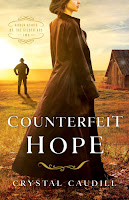
Trapped by their pasts, is there hope for a future?

When Secret Service operative Andrew Darlington is brought in to support a US Marshal case involving counterfeiters in rural Indiana, he thinks it's simply the next rung on his climb to the top of his career. But liars can only climb so high--and Andrew is keeping a dangerous secret he doesn't ever want to get out. When he clashes with the criminal family that took over the town of Landkreis and killed the Marshal he was sent to assist, his past life is in danger of being exposed.

Widow "Lightning Lu" Thorne has only one goal: escape the clutches of the Thorne family with her son. Her decision to be an informant and testify against the Thornes looked like the perfect answer. Until the Marshal ended up dead. Now the tether keeping her tied to her felonious family is tightening, and a forced marriage to someone else in the Thornes' clutches threatens to kill any hope of escape.

Andrew and Lu find themselves on the same team--unwillingly. They each believe the other to be the enemy of their future plans. And even if they could learn to work together, the secrets they hold could shatter all hopes and dreams. Despite the encouragement of the local preacher, they're not even sure God can be trusted--much less other humans. Can either of them escape their past--and the family that is willing to kill their own when they smell betrayal?

Pre-Order Link: Coming February 2023

Wednesday, November 2, 2022

Traveling Tuesday: Westward Expansion

Traveling Tuesday: Westward Expansion

American Progress, 1872
by John Gast
The move into the American West began around 1810, about seven years after President Thomas Jefferson purchased the territory of Louisiana from the French government for $15 million. Nearly doubling the size of the United States, the area stretched from the Mississippi River to the Rocky Mountains and from Canada to New Orleans. Jefferson keenly believed that the health of the republic depended on the independence of its citizens, and that land ownership was a key to that independence. He wrote, “Those who labor in the earth are the chosen people of God.”

By 1840, almost forty percent of the U.S. population (about seven million people), lived in the trans-Appalachian West. Using the trail blazed by Lewis and Clark, these people sold most of their worldly goods to purchase a wagon, a pair of oxen, and enough food (hopefully) to get them across the country. Most were searching for economic opportunity, but many were looking for adventure.

Americans weren’t the only people to trek the trails. Europeans came in droves, and the reasons are as
Courtesy National Geographic
numerous as the people themselves. Like the Americans, some hoped to earn a living. Others fled religious or political persecution. Still more were escaping starvation (such as when the Irish came between 1845 to 1849 because of The Great Famine). The California Gold Rush and subsequent Alaskan Gold Rush also brought thousands of people.

In 1845, journalist John O’Sullivan espoused that westward migration was “Americans’ manifest destiny to carry the great experiment of liberty to the edge of the continent: to overspread and to possess the whole of the [land] which Providence has given us.” He may have coined the phrase, but it was a belief long held within the U.S.

The Preemption Act of 1841, The Donation Land Act of 1850, and the Homestead Act of 1862 enticed spurts of mass immigration. There were two wagon-based transportation networks, one starting in Missouri, the other in the Mexican province of Santa Fe de Nuevo Mexico. Known as the Emigrant Trails, the Oregon, Mormon, and California trails began in Missouri, and historians have estimated that at least a half-million people traversed these three trails between 1843 and 1869 (the height of expansion). The Gila Trail, Sante Fe Trail, and Old Spanish Trail were the “southern routes.”


No matter what trail was used, the journey was arduous and slow and fraught with dangers. Infectious diseases, dehydration, malnutrition, injury, and inclement weather caused the deaths of as many as one in ten travelers. Most settlers paid to be led by a wagon master who was in charge of a large party or “train” of up to several hundred wagons. Some of these masters wrote trail guides or memoirs, and it wasn’t until 1859, the government published The Prairie Traveler, written by Capt. Randolph Marcy who'd spent most of his career in the American West.

Competition among the territories was fierce, and some offered “incentives” to lure settlers, such as Wyoming which was the first state to give women the right to vote. Once the journey was complete, the danger wasn’t necessarily over, but immigrants built “soddies,” homes made of dirt and grass, then set about carving a living out of the plentiful and fertile land of the West.
______________

Dinah's Dilemma

Will she have to run from the past for the rest of her life?


Dinah Simpkins has no chance of making a good marriage. Her outlaw brothers and her father’s gambling addiction have ruined the family’s reputation. Then the Westward Home and Hearts Matrimonial Agency provides an opportunity for a fresh start. After Dinah arrives in Nebraska, she discovers her brothers played a part in the death of her prospective groom’s first wife.

As a former Pinkerton detective Nathan Childs knows when someone is lying. The bride sent by the matrimonial agency may be beautiful, but she’s definitely hiding something, and he has no intention of marrying her until he uncovers the truth. But an easier solution may be to send her packing. Then his young daughter goes missing. He and Dinah must put aside their mutual hurt and mistrust to find her.

Purchase Link: https://amzn.to/3TrdXqc

Friday, October 28, 2022

Fiction Friday: Gone with the Draft

Fiction Friday: Gone with the Draft

I love to haunt old bookstores because of the unexpected treasures I find. One book I’ve had for several years is Park Kendall’s Gone with the Draft: Love Letters of a Trainee. Published in 1941 by Grosset & Dunlap, the book is a fictionalized account of one man’s experience in an army training camp. Rather than written in a prose format, the book is comprised of letters from Joe to “my dear Annie” and “my moast prescious jewell (sic) and interspersed with illustrations by Irving Politzer, a successful artist who was the son of Hungarian immigrants living in New York City.

Very little biographical information is available for Mr. Politzer, and I couldn’t find any photos of him. I was able to discover that he served in World War I, and his draft card indicates he was an apprentice for Allendorff Studio (which is perhaps where he got his start as an artist). His father passed away in 1919, so Politzer lived with and supported his mother until her death in the mid-1940s. He married a dress shop owner named Tesse Sharpe in 1946, and they remained married until his death in 1971.

I couldn’t unearth any information about the author, and the book’s dust jacket is missing the back, so
if there was any biographical data on the fly leaf, it’s long gone. At some point, he also published a second book Still in the Draft published by M.S. Mill Co. in 1942. Perhaps, the writer is just a “regular Joe” who eventually came home from the war, married his Annie, finished his education through the GI bill, got a job, and lived happily ever after. I’d like to think so.

The Veteran’s Administration claimed the book is “a worthy successor to Dere Mable.” {Written by Edward Streeter and published in 1919.} The Honolulu Advertiser crows: “The book is all laughs but underneath is a loyalty and love of County.” “Very amusing. The diction of army slang is well worth the price of the book,” touts the Dallas Times Herald.

And speaking of army slang, here are a few phrases from the book:
  • Angel: Anyone who buys a drink
  • Barrow Jockey: someone who pushes a wheelbarrow
  • Cinched the bread: took the last pieced and didn’t refill the dish
  • City Cow: canned milk
  • Horizontal Pleasure: Sleep
  • Sand and Specks: Salt and Pepper
  • Toot: Money
____________

Will a world at war destroy a second chance at love?


Estelle Johnson promised to wait for Aubry DeLuca, but then she receives word of his debilitating injuries. Does she have the strength to stand by him in his hour of need?

Aubry DeLuca storms the beaches at Normandy, then wakes up in the hospital, his eyes bandaged. Will he regain his sight? Will the only woman he’s ever loved welcome him home or is he destined to go through life blind and alone?

Purchase Link: https://amzn.to/3SuXWPI

Thursday, October 27, 2022

Talkshow Thursday: Meet Aubrey Taylor

Talkshow Thursday: Meet Aubrey Taylor

LM: Welcome! Congratulations on your upcoming release The Prodigal Sons, Gott Mit Uns, Book 2. I can't wait to read it. The premise of your book is fascinating – there don’t seem to be many WWII novels written from the German viewpoint. What was your inspiration for the story? How many books can we expect in the series?

Aubrey: Thank you, Linda! In March 2021, I was contemplating how I was going to reconcile my growing appreciation for our family’s German heritage with our upcoming homeschool study of the world wars. While these are not YA books, that’s where the inspiration began. It was almost as if God tapped me on the shoulder and gave me the concept for my first novel, Sani: The German Medic. I hadn’t written creatively in decades. Was I willing to take a step of faith?

In the process of writing that first book, there were characters whose lives ended during the war, yet I just wasn’t ready to let go of them. I had also fallen in love with the Schmidt family. As I prayed more about the whole concept, I knew that I was going to create a family saga. The Prodigal Sons (TPS) goes back to 1923, with a prologue set in 1915, and really sets the stage to allow the reader to better understand the Schmidt boys.

As far as books in the series, I’m hoping for at least 4, but I actually have concepts for Schmidts and close family friends all the way into the future. We’ll see what develops.

LM: What research did you do for the story, and is there a particularly intriguing tidbit you knew had to be included?

Aubrey: To truly understand the experience of the German people, you have to go back centuries.
Pixabay/Alexander Naumann
What a fascinating and sometimes tragic history they have. I began with a book called Germany: Memories of a Nation, and I continue to explore the more distant past when I have time, although most of my research for TPS centered specifically on the Weimar Republic and the origins of the Third Reich. I’ve read parts or all of memoirs written by former soldiers of the Wehrmacht, members of the Hitler Youth, and the SS, as well as The Rise and Fall of the Third Reich and various other in-depth histories. I do a lot of internet research, listen to podcasts and, most blessedly, talk to dear people I know who lived through the tragic past or who have researched it in-depth themselves. Also, my husband and I spent three wonderful weeks in Germany this past summer!

LM: In addition to writing, you homeschool and are involved in ministry. How do you balance your responsibilities?

Aubrey: I actually don’t homeschool anymore, though I did for six years. I loved every minute of it, but the Lord knows how much I can balance, and when He made it clear that He was calling me to be an author, he impressed on my heart that it was time for us to place our children in school. He’d whispered to my heart years ago that my oldest would attend school in sixth grade. That’s exactly when all this happened!

That said, there is not a dull moment. I do lead worship at church a few times a month, I’m involved in a German choir, and have also been learning a lot of German and popular songs to join my choir director for some of her other gigs (she’s an incredible singer and accordion player!)… I have to start each day bringing my priorities before God, and place special emphasis on the things I know He’s brought into my life. Sometimes it means saying ‘no’ to other things!

LM: Tell us about your road to publication.

Aubrey: Like many authors, I wrestled with the idea that I had to be formally published before deciding to go with KDP. What it came down to for me was feeling that it was more important to find ways to share the things God had placed in my heart, rather than wait in the hopes of gaining broader publication which may never come. I would rather do a little networking and legwork (which has actually been fun) and trust God to get the book where it needs to go. I’ve been amazed at how far it has gone. There are so many opportunities for authors online, such as your blog!

LM: What do you do to prepare for writing? (e.g., listen to music, set up in a certain place)

Aubrey: Most importantly, I try to spend time reading my Bible and in prayer before I write. That doesn’t always happen! When inspiration hits, I have to get it down, even if it means using the voice recorder on my phone. I carry my Schmidt family in my heart all the time. I used to play music while I was writing, but now that I know them so well, whenever I’m listening to music, even if I’m cooking, cleaning, or in the car, phrases will catch me and I can feel their hearts or their circumstances. I see them in my reading and in every period film I watch. In some ways, I live as much in their world as I do in my own. My 10-year-old thinks I’m weird, but I hope it makes the story better!

LM: What is one thing you wish you could do?

Aubrey: Someday, I would love to see some or all of the GMU books translated into German.

LM: What advice do you have for fledgling writers?

Aubrey: Just write, every day. If you’re working on a novel, just write. You can pull stuff out of the manuscript later (and don’t be afraid to – I have a separate folder on my computer entitled “Not Ready to Delete” where I put all the stuff I’ve pulled out!) Also, people need to read your story. Unless God has really made it clear to you that you need to seek formal publishing, indie publishing is an option and is not as hard as you think. Don’t worry about the size of your audience, or compare yourself with anyone else. Yes, there are a lot of books out there, but yours isn’t just white noise. If He’s given you something to say, He will make sure it is heard.

LM: Where can folks find you on the web?

Aubrey: I have a website at http://www.aubreytaylorbooks.com. It’s still very “homegrown,” but you can subscribe separately to both my newsletter and my blog, as well as access the first few chapters of Sani for free. When it releases, I hope to put an excerpt from TPS up there as well.

My social links are:

Facebook: https://www.facebook.com/aubreytaylorbooks/
Instagram:https://www.instagram.com/aubreytaylorbooks/
Twitter: https://twitter.com/aubtaybooks

About The Prodigal Sons:

Weimar Germany, 1923. A father, a son, and a cousin.


Ernst was born too late to fight alongside his brothers in the Great War. An alcoholic and brawler, he finds his place in Germany’s postwar struggle by throwing in his lot with the burgeoning Nazi Party. Yet the failed Putsch attempt brings him home to stay for the first time in years.

Jakob is a young prodigy and church musician who wants nothing more than to spend time with his childhood sweetheart and live a quiet life of service to God. Yet this is not the world he was born into.

Friedrich is a German-American who remained in Germany after fighting with the Allies in the Great War. After healing from a life-threatening injury sustained in October 1918, he’s become a devoted husband and man of God who is loved and admired by all. Yet can there truly be forgiveness for the sins of a past that continues to haunt him?

Written as a prelude to Sani: The German Medic, this book stands on its own or can be read in sequence, bringing the reader deeper into the history of the fictional Schmidt family as they wrestle through the tumultuous Twentieth Century in Germany.

Pre-order Link: https://amzn.to/3T4ovLD

Wednesday, October 26, 2022

Wartime Wednesday: From Reporter to Spy

Wartime Wednesday: From Reporter to Spy

WikiImages
One of my favorite research books is Sisterhood of Spies written by Elizabeth “Betty” Peet McIntosh. She highlights the exploits and bravery of women who served in the Office of Strategic Services (OSS), and I didn’t realize until I’d reached the end of the book that she also served.

Born in Washington, DC to parents who were both reporters, Betty was raised in Hawaii and learned to speak Japanese. After graduating with a degree in journalism from the University of Washington in 1935, she worked as a correspondent with the Scripps Howard news service. Stationed in Hawaii, she was in Honolulu during the attack at Pearl Harbor. Shortly, thereafter she moved to Washington, DC where she covered Eleanor Roosevelt and governmental activities.

In 1943, knowing of Betty’s fluency in Japanese, she was recruited to join the OSS by a family friend
WikiImages

who asked her if she “wouldn’t like to do something more interesting than the work you’re doing.” Her response: Only if she could go overseas. The man assured her he could guarantee her wish, but the word spying didn’t enter the picture until after she signed on. Once her training was completed, she was sent to India, then also stationed in Burma and China. In all three locations, she was part of Operation Morale, where along with future chef Julia Child, she created “disinformation,” documents, and postcards aimed at undermining Japanese morale. She also developed propaganda leaflets.

One site told about an assignment during which she helped create a radio script for a popular Chinese fortune teller. Part of the script said, “something terrible is going to happen to Japan. We have checked the stars and there is something we can’t even mention because it is so dreadful and it is going to eradicate one whole area of Japan.” Later that day, the atomic bomb was dropped on Hiroshima, an event McIntosh and her team had not known about prior to writing the script. Later, she would be involved in a mission to deliver “black Joe,” an explosive disguised as a lump of coal. Her responsibility was to pass the “coal” to an operative who smuggled it onboard a train ferrying Japanese soldiers.

Pixabay/DiGiFX Media
She remained with the organization when it became the CIA and met her husband, a “dashing young pilot” while in Asia. They married in 1962. She continued to work until her retirement in 1973, indicating that the atmosphere at the CIA was different than that in the OSS: “There was a little bit of bureaucracy, which had set in like rigor mortis above us, and some people were sort of…they didn’t have imaginations…they didn’t want to do things as we did in the OSS.”

She passed away in 2015 three months after her one-hundredth birthday.

________________

Will a world at war destroy a second chance at love?


Estelle Johnson promised to wait for Aubry DeLuca, but then she receives word of his debilitating injuries. Does she have the strength to stand by him in his hour of need?

Aubry DeLuca storms the beaches at Normandy, then wakes up in the hospital, his eyes bandaged. Will he regain his sight? Will the only woman he’s ever loved welcome him home or is he destined to go through life blind and alone?

Purchase Link: https://amzn.to/3SuXWPI

Thursday, October 20, 2022

Talkshow Thursday: Welcome Judith McNees!

Talkshow Thursday: Welcome Judith McNees!

Linda: Welcome! Congratulations on your recent release A Heart to Trust (A Tranquil Shores Romance, 2). What was your inspiration for the story? How many books can we expect in the series?

Judith: Thank you so much! Grace and Ty, the hero and heroine in this story, are very loosely based on my husband and me. The main Tranquil Shores Romance series has five books; however, I am also planning on a novella based on a side character from book 1 of the series that will go on my website as a gift to newsletter subscribers, and I’m currently writing a Christmas novella based on a side character from A Heart to Trust!

LM: You have traveled extensively. How has that informed your writing? Did you have a tough time deciding on where to set your story?

Judith: I’m a vacationer that skips buildings and relaxation to explore the wilderness, much to my husband’s chagrin. The primary way this informs my writing is through my descriptions of nature. Setting my series in Michigan was an easy choice for me. I adore vacationing in my home state and wanted to share its beauty with everyone.

LM: What research did you need to do for the story, and is there a particularly intriguing tidbit you knew had to be included?

Judith: I had to do a lot more research for this book than I did for book one. Most of it had to do with
Pixabay/Wolfgang Claussen
legal issues in Michigan. I also researched horses, Michigan centennial farms, a medical condition that would be a spoiler so I’ll stay tight-lipped about that, and car problems in a Honda with push button start. I was intrigued when I learned that most horses need special training to allow their rider to open a gate while mounted.

LM: Tell us about your road to publication.

Judith: Yikes. I honestly thought that finishing and publishing book two would be fast since I had a little under half of it written when book one came out in April. Once I published A Heart to Cherish, a lot of health and family issues came up. The nice thing about indie publishing is there are only self-imposed deadlines, so I gave myself a lot of grace, except when I chose a publication date of September 28 and put the book up for pre-sale. I was editing and proofreading all day long for about a month straight to hit that deadline.

LM: What do you do to prepare for writing?

Judith: A lot of praying!

LM: What is one thing you wish you could do?

Pixabay/Roland Mey
Judith: I’d love to cruise the United Kingdom…especially Ireland.

LM: What advice do you have for fledgling writers?

Judith: Don’t try to figure everything out. Just start! When I first decided to write, I was paralyzed trying to figure out how to publish. Once I let go of fear and put it in God’s hands, He provided every resource I needed right when I needed it.

LM: Where can folks find you on the web?

Judith: You can connect with me on my 
Amazon: https://www.amazon.com/Judith-McNees/e/B09SW364TT

A Heart to Trust:

Can two broken hearts learn to trust each other…and God?


Grace Morgan has a closely guarded secret. One that also makes her good at guarding her heart. After all, she has what she needs to be content. She won’t make the mistake of falling for another man at work…until the hunky new guy she’s trying not to notice moves in across the hall. Tyler Danby has a secret, too. Left by his wife, who takes away everything he cares about, he’s nursing his wounds and starting over. When he strikes up a friendship with his quirky neighbor, he wonders whether God might be giving him a second chance at love.

Secrets have a way of coming out. And broken trust is hard to restore.

Purchase Link: https://amzn.to/3SNCqFS

Wednesday, October 19, 2022

Wartime Wednesday: Parachutes and Wedding Dresses

Wartime Wednesday: Parachutes and Wedding Dresses

I’ve been married thirty-nine years this month, but I remember the search for my wedding gown as if it was yesterday. One Saturday morning shortly after I got engaged, my mom informed me that we were going to go “window shopping” for a wedding dress. Indicating that she and Dad weren’t sure what sort of costs were involved, they wanted me to do some reconnaissance. I’m not much of a shopper, but this was different. This was a once-in-a-lifetime garment that I’d wear, and I wanted it to be special. I didn’t think we were poor, but with my father as the only breadwinner, four children to raise, and having just finished putting me through college, I figured they didn’t have a whole lot of extra money.

Of we went, in one store after another. The blur of frothy white gowns became overwhelming. I began to worry that I’d never find anything. In one shop, I watched a daughter and her mother argue over the “perfect” dress. Apparently, Mama wanted the world to know they could afford to spend heavily on the gown. Every dress she selected was embellished with sequins and beads. The daughter wanted a simple Grecian gown. We left, and I’m not sure who won.

At our last stop, I donned a dress that brought tears to my eyes, but I hesitated to tell Mom, thinking
we were still only window shopping. She must have seen the look on my face because she said, “That’s the one, isn’t it?” I nodded, and she grinned as she pulled out her checkbook. “Surprise! If you really want it, I will buy it.” I was flabbergasted. The dress cost $210 – a huge amount in my eyes because we’d signed an apartment lease with a monthly rent of $484.

Since the beginning of time, women have wanted a special dress for their wedding, but times of war sometimes thwart the effort. During World War II, fabric was rationed and difficult to find in some cases. As a result, the trend began to make bridal gowns from parachute silk (or nylon). The standards for parachutes were stringent, so if any fault was found, the item became available as surplus and available for purchase.

Author Photo
Some women used the chutes that saved their fiancés’ lives, while others’ loved ones brought home parachutes they’d taken from enemy soldiers, German and Japanese primarily. One site told of a Bergen-Belsen survivor wearing a dress reportedly made from a German soldier’s parachute. Talk about a meaningful dress. Another site told of an American soldier who used his parachute to propose rather than a ring (hopefully, she received a ring later!)

The size of the parachutes enabled women to create dresses with voluminous skirts, puffed sleeves, long trains, and ruffles. Lots of the dresses were passed down through families, and in recent years many of the dresses have made their way into museums. The Wright Museum where I am a volunteer docent is fortunate to have one such dress. The gown is so small, we had to create a form on which to display it; modern dress forms are too large.

__________________  

Will a world at war destroy a second chance at love?


Estelle Johnson promised to wait for Aubry DeLuca, but then she receives word of his debilitating injuries. Does she have the strength to stand by him in his hour of need?

Aubry DeLuca storms the beaches at Normandy, then wakes up in the hospital, his eyes bandaged. Will he regain his sight? Will the only woman he’s ever loved welcome him home or is he destined to go through life blind and alone?

Purchase Link: https://amzn.to/3SuXWPI